Thursday, May 14, 2009

conversation with Dr. Fine
(NIH/NCI, Neuro-Oncology Dept.)

Please come back to this post periodically, as I upload the transcript of the conversation in segments. As I discovered while doing transcription work in Korea, it takes me about 7 hours to write up and polish 30 minutes of dialogue. The exchange with Dr. Fine, et al., of the NIH/NCI Neuro-Oncology Department lasts about 35 minutes. I began recording this particular segment after the conversation had already begun, but the missing material is little more than introductory pleasantries.


DR. FINE (to Mom): Now that you know that there was a problem, can you date back any symptoms further than... a couple months...?

MOM: I can't go too far.

FINE: You can't go back too far?

MOM: I was doing fine, and then, suddenly, like, sixteen [i.e., April 16], I just, you know, kinda little bit lost or something. And so they [i.e., the men of the family] said, "You gotta go to the hospital." And, you know, I went to the hospital.

FINE: In the couple months building up to that, nothing? Did you notice anything?

DAD: Nothing, except for what I thought might have been something a little bit less than usual, and I was saying to them [i.e., the sons] before, conversationally, where there seemed to be less conversation-- in other words, not so much initiation, but simple answers, to the point where, historically, I would have thought, "Uh-oh, I'm in the dog house for some reason," you know, and when I asked her directly that, she said, "Don't be silly, don't even talk like that." So right away, that was out as fast as she was saying that. So it had to be something else, but nothing else happened, and I wasn't putting, if you will, two and two together until Kevin, you know, mentioned what his experience was on Thursday morning. And I'm sure that Dr. Chowdry and, uh, the other doctor [Dr. Iwamoto] mentioned to you about it. So, based on that behavior... yeah.

FINE (responding to page): Can you give me one second? I need to get this. Thanks. (Exits.)

DR. CHOWDRY: So the CT, uh, the MRI that we do after the radiation and Temodar [chemo drug] is gonna be the baseline.

DAD: OK.

CHOWDRY: That is the baseline that we are gonna compare to when we do Temodar and then get the MRI every two weeks, OK? So this [i.e., the CT and MRI images from Fairfax Hospital] is not what we are gonna look at, what we just looked at today.

DAD: 'Cause you're gonna start--

CHOWDRY: We're gonna start post-radiation; that's our baseline. So every time we go back to...

DAD: So post-radiation is when everything starts. Well, yeah, that's logical. I understand that, 'cause that's when your research starts, and that's what happens there, to see if there's been any change.

SEAN: Did you say after she's done with radiation?

CHOWDRY: (inaudible, but probably a "yes")

DAD: Now, is that the full course of radiation, or the first 42 days?

CHOWDRY: The total course of radiation--

DAD: Six months or whatever it is?

CHOWDRY: Let Dr. Fine speak; he'll fully explain it.

FINE (reentering the room): Yeah, so-- I know you've spoken to a number of doctors. Lemme kinda' just give you my perspective on this, as someone who's seen about sixteen to twenty-two thousand patients with this disease over the last twenty years.

The first thing I should tell you is that the surgery you had was outstanding. It was a superb job, and I don't think there's any more role for any additional surgery at this point, and that's saying something, 'cause we see thousands of folks from all over the country, and many times, the surgery they get is sub-optimal, and we often have to do a second surgery. But thankfully, in your case, your surgeon [Dr. Leiphart at Fairfax Hospital] did a great job, so that's important.

MOM: OK.

FINE: The kind of tumor you have is a called a "glioma," and a glioma is what we call a primary brain tumor, meaning it's a tumor that starts out in your brain. It doesn't come from anywhere else. The good news [is that] it doesn't go anywhere else. You don't have to worry about it spreading to your lungs or your belly, so that's good. But obviously, it's in a pretty important part of the brain.

DAD: Or other parts of the brain?

FINE: Well, so, that's what I was gonna say-- talk about. The problem with this tumor is it's not as simple as having a lump in your head. If it was as simple as a lump in your head, then in the hands of a good brain tumor neurosurgeon, you could just kinda' scoop it out, like a plum in a pudding, and be done with the problem.

DAD: Right.

FINE: What this tumor is actually made up of is many, many millions of individual tumor cells. Each of these tumor cells kinda' lives a life of its own, and the major things these tumor cells can do is-- first of all, they can move within the substance of the brain. They don't jump around, but within millimeters, they can kind of move in between the normal cells in the brain-- what we call "infiltrate" the brain.

And the other thing these tumor cells can do is they can divide, so one becomes two, two becomes four, four becomes eight, and that's essentially what we call the growth of the tumor.

And the pattern of these tumor cells, relative to how they sit in your brain, is somewhat analogous to... if you think of a situation where-- if you think of your brain as this beautiful lawn of grass, and each one of the normal nerve cells in the brain is like a blade of grass, each of the tumor cells is kind of like a grain of sand, and it's as if somebody threw a hand of sand on your lawn. If you keep with that analogy, what might you end up with? Well, you'd probably have a pile of sand, and that's actually what your surgeon removed, appropriately. Got rid of that pile of sand, so that, you know, 90% of the grains of sand, the tumor cells, are removed.

But in keeping with that "throwing the sand onto the lawn" analogy, what you're also gonna end up with is some grains of sand flew over there, flew over there, flew over there, and it's all mixed in, now, with the normal lawn, so that you can't even see those individual tumor cells. So if you physically wanted to remove every last tumor cell, you'd essentially have to pull up the lawn. Well, we don't want to pull up your lawn, because your lawn's pretty important stuff: it's your brain. We can't do that. so the strategy for treating this tumor is to do exactly what's been done so far. There's a pile of tumor cells-- which there was-- remove it, which in your case, that's great, 'cause we got rid of at least 90% of the tumor, if not more.

But the rest of the tumor cells now are so intermixed with important brain tissue that we don't have the luxury of just being able to take the whole thing out without causing irreversible and unacceptable damage to you. So we have to figure out a way of killing off those last few tumor cells without hurting all the intervening normal tissue.

And we've made a lot of advances in this field.

[stopped at 00:06:50; more to come]


_
special meal

Lunch today was the remains of a Costco rotisserie chicken, multi-grain rice, Korean seafood soup, and a mess of Korean side dishes. Nothing special for a Komerican family, right? Lots of spicy leftovers.

But today, it was Mom who went to the fridge and brought out the meal's elements, Mom who plated those elements, Mom who asked whether Dad and I had enough food on our plates.

Nothing special? Considering all that's happened, I'd say today's lunch was one of the best I've ever had.


_

Wednesday, May 13, 2009

back

We're back from our trip to Fairfax Hospital. The meeting with Dr. Tonnesen went well; I recorded that session, but will probably offer only a summary of it. Most of the information we heard today amounts to a review of what we already learned during trips to the National Cancer Institute and to the M.D. Anderson Cancer Center in Houston.

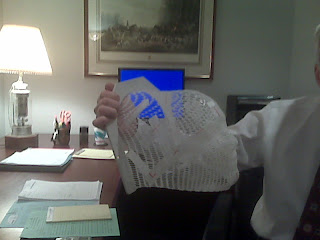
Mom also had her radiotherapy mask made; the procedure involved the making not only of the mask, but also of the neck mold, which is shaped to Mom's dimensions to allow her head and neck to settle as comfortably as possible in an inclined position. The goal of all this is to allow Mom to remain comfortably still during the radiation treatment. As I noted in a comment to my brother in the previous post, I must have misunderstood the mask's purpose: while the mask is indeed there to aid in the precise aiming of the radiation, it is not a surrogate for Mom's face: to the contrary, it is to be worn during every treatment, and its sole function is to keep Mom still.

Mom is slated to begin treatment on May 21. This is currently a tentative date, but it's very likely to be the official one. Her radiotherapy will occur in the early to mid-afternoon for six weeks after the start date. Dr. Tonnesen wants to take "baseline" scans a couple months after the treatment is over, but we'll be taking Mom to NCI right after the 6-week treatment to see Dr. Fine and his people; they'll be scanning her to create their own baseline. I informed Dr. Tonnesen of this, and he said that that would be no problem, even though the NCI scan would be occurring so soon after the radiation.

Upshot: the ball is rolling. Mom knows to expect major, patchy hair loss to begin sometime around the third week of radiotherapy. She also knows to expect a long list of possible side effects resulting from the radiation and/or the Temodar treatment (I need to review that list; we have it on a sheet they gave us). We'll all be there for her during this trying period, but what this means for friends and non-immediate family is that it will be all the more important to plan their visits instead of just dropping in suddenly. Mom is likely to be very tired, especially during that initial 6-week period. Dr. Tonnesen noted that, during that time, many patients seem almost to be regressing instead of progressing, but that this is a normal part of the process.

OK... gotta go make dinner. More later.


_

an example of the radiotherapy mask that will be molded to fit Mom's face (Dr. Tonnesen's arm in pic)

Sent via BlackBerry by AT&T

going soon

We're off to Fairfax Hospital for Mom's 1PM appointment with Dr. Tonnesen, the radiologist. At 3PM, Mom has another appointment in a different building, this time to get a cast of her face made. The cast will be turned into a sort of mask that will be used as a contour guide to aid in the precise aiming of the radiation. The mask allows the docs to practice their aim without directly involving Mom.

More later.


_

Tuesday, May 12, 2009

pelouse tondue and other things

Dad and I hacked away at our unruly front and back yards today, starting around 10AM and working until, oh, a few minutes ago. While both yards have essentially become a mix of weeds (there's very little actual grass there, but I was comforted to note that many of our neighbors are having their own clover, dandelion, and crabgrass issues), the buzz cut at least presents passersby with the illusion of orderliness. About one or two weeks from now, we'll probably have to do it all again.

Personally, I'm not a fan of lawn care, not because I hate the work (on the contrary, I generally find it meditative, like washing dishes), but because it seems to be one of those vain human activities that perpetuates a "man versus nature" dichotomy. Alas, the imperative to care for one's own lawn comes from the neighbors: allow too many dandelions in your yard, and your neighbors will worry about all those seeds wafting over to their own lawn. Even if you don't "keep up with the Joneses" in terms of what technical gadgets you own, you have to keep up with them when it comes to lawn care. And that's vanity, too: maintaining appearances for the neighbors' sake. Such is suburban life.

Mom saw me come in after my sweaty effort (I did the mowing and grass-bagging; Dad did the trimming and stick-bagging; he also combed the back yard for any debris left over from the renovation). When I declared I was done and that both lawns had been mowed, Mom shook her head and "tsk"ed me.

I'm getting better at decoding what this new Mom means when she does this sort of thing. Because of the damage to her frontal lobe (if you saw the post-surgical MRIs, you'd see just how much had been removed from the left frontal lobe, and even partially from the right frontal lobe), Mom's inhibitions have been somewhat reduced. Whatever her first thought is, this is what burbles to the surface of her consciousness and gets expressed. "Tsk-tsk," in this case, refers to the grungy state I'm in and the effort I must have put into the yard work. Were Mom capable of more complex, nuanced reactions, she doubtless would have followed up with her normal "Thanks."

Despite understanding all this, I deliberately asked Mom why she had "tsk"ed me. I often pepper her with occasional "why" questions, because I want the undamaged parts of her brain to start to pick up the slack, to do some cognitive heavy lifting, to make Mom once again aware of-- and responsive to-- the causal connections between events. "Why" provokes "because," and "because" requires elaboration of the initial thought. As a language teacher who spent eight years in Korea, I quickly discovered that yes/no questions were death in the classroom (a fact also known by American mothers who try to ask "tween" and teenage children about their day). To provoke thoughtful responses, you have to stick with "wh-" questions.

Mom's response to my "why" question was silence, which has been par for the course since her operation. I don't care that she was silent this time; my hope is to keep at this problem in a gently persistent way until we achieve some minor breakthrough.

For those who are curious about how all this has affected Mom when she's in Korean-speaking mode: there's no real difference. Because she's a fluent* speaker of English, her performance in both languages is about the same (changing back and forth between Korean and English during conversation is what linguists call code switching). Asking "why" in English or asking "wae" in Korean will elicit the same reticence in Mom.

Tomorrow, we're off to Fairfax Hospital for Mom's appointment with Dr. Tonnesen, the radiologist in charge of the radiotherapeutic aspect of Mom's treatment. Mom gets the cast of her face made tomorrow as well; it's possible that her in-tandem radiation and Temodar treatment will begin the following day. If not Thursday, the I'm guessing it will all start the following Monday.

Once Mom's routine has been set, I need to start looking for work. Being home like this is a financial burden on the folks (large guys eat a lot and have piles of laundry), and I've been jobless since the second week of April. My original intention had been to quit the proofreading jobs and give myself a free week to prepare more comfortably for the upcoming walk; I quit work around April 10, with the intention of leaving for the Pacific Northwest on April 18. Since Mom's symptoms manifested themselves on April 16, things have veered-- like the new "Star Trek" movie-- into an alternate time line. We are all now living an unanticipated sequence of events.

But money counts, and I need to be working, if for no other reason than to service my own monthly debts and keep myself from becoming too much of a burden to my folks, who are still smarting from the house's massive renovation. Ideally, I need to get a job similar to what I was doing-- whatever keeps me at home and on call is better than a job that requires a commute plus office hours. I'm going to try to find something local; in working for those Korean companies, I inverted my sleep schedule until I had become a vampire-- sleeping from 5AM to noon, working most of the day and into the night, taking breaks for dinner, and barely interacting with my parents. Whatever job I find, it needs to come with normal sleep hours.

One quick update (This Just In!) before I end this post: Mom is apparently upstairs fixing dinner for us. One of her friends is coming over to deliver some Korean food for Mom, so I'm curious as to what Mom is preparing, and whether she means it merely to supplement whatever her friend is bringing, or whether she means it to be eaten exclusively by us guys, while she focuses on the Korean food. The only way to find out which alternative is correct is for me to sign off here, so...


*Fluent doesn't mean perfect: a person can speak with perfect grammar and have an accent; another person might have great listening skills, but have grammatical troubles; fluency is a hard concept to nail down, but as the word's Latin root implies, it's related to one's ability to handle communicative situations in a fluid, flowing manner.

In Mom's case, she has long understood full-speed American English, up to and including many slang and idiomatic expressions. She speaks with an accent and makes some grammatical errors, but she makes herself understood clearly and in a short amount of time. The ability to express oneself succinctly means that one has command of a large active vocabulary; a smaller active vocabulary forces one to resort to circumlocution ("talking around") to express even simple thoughts in a second language.


_

to the reader in Huntington, Maryland

Dear Reader in Huntington, Maryland:

Thanks for dropping by the blog. I see that you've been using Google to search for the blog, and that you've come by several times using the same search string, "kevinswalk.spotblog.com."

Please be aware, however, that you've been repeatedly typing "spotblog" for the domain name. It's actually "blogspot," i.e., "the spot where you find the blogs." A lot of people hate BlogSpot; an easy way to remember the domain name is to abbreviate it mentally as "BS."

I hope this helps. You can also add the blog to a "favorites" list on your browser so that you don't have to type the URL into Google every time.

Say howdy in the comments if you like.


_

Monday, May 11, 2009

apologies

I'm sorry there haven't been any updates before now. Yesterday was Mother's Day, so I decided to slack off. Today, there's little to report, except that I'm increasingly becoming the head chef in the house, as Mom doesn't feel much like cooking. This works fine for me; I enjoy cooking.

Dad called Fairfax Hospital to find out whether Mom can have her radiotherapy mask made on the same day as her appointment with Dr. Tonnesen, the radiologist; the hospital said yes. (The hospital has to create a cast of Mom's face to aid their machines in aiming the radiation more precisely.)

My brother Sean dropped by this morning; he's promising Mom that he'll be bringing Maqz the chihuahua over tomorrow. David's coming over tonight with food for Dad. Because I stepped out for a short while with my buddy Mike, poor Dad almost had to cook dinner for Mom this evening-- an interesting prospect, since Dad claims he can't cook. I had shown him a bunch of Korean food that he could reheat; he was getting ready to do that when I walked back into the house.

Mom continues to exhibit blunted affect: her emotions just don't seem as strong as they used to be. She occasionally rouses herself from staring at the TV to ask questions like, "Are you going out wearing that?" (Yes, that was addressed to me; I've never been a fan of button-down fashion, preferring to dress like a slob whenever possible.) She seems concerned about goings-on inside the house, but doesn't seem proactively motivated to bustle around the house the way she used to. This isn't a critique: Mom's surgery was only a few weeks ago, and we can't expect her ever to heal fully. It does worry me, though, that this might be the new Mom from here on in.

Dad noted, last night, that Mom seems fine when she interacts with us three sons, but her temper is shorter with Dad. She gets annoyed with him very easily, usually about nothing important. It's a strange thing to witness: on the one hand, Mom doesn't seem to feel things as deeply anymore; on the other, her talk often seems more blunt and frank (the frontal lobe is related to inhibitions), and I too perceive that she gets a bit edgy toward Dad in particular. But are these repressed feelings coming out, or simply emotions distorted by a combination of cancer, surgery, and medicine? It's hard to know. For the moment, I lean toward distortion, because Mom has made some wildly inconsistent remarks to us.

I do know that Mom doesn't like to hear talk about doctors. Whenever Dad and I mention her treatment in her presence, she'll turn from the TV and declare, "OK, that's enough." Never forcefully, never with a tone of overt resentment, but in a manner that indicates she's tired of hearing about herself.

Many thanks to Mrs. Burns for dropping off a lovely soup and a bunch of fruit. Thanks, as well, to the good folks who continue to mail Mom get-well cards. The kind gestures are appreciated.

I'll be continuing the Dr. Fine transcription soon. From now on, I'll push that post to the top of the queue every time I make an update.

Oh, yes: Mom's appointment with Dr. Tonnesen is this coming Wednesday the 13th. She's also got to make her radiotherapy mask that day, so we'll be out of the house for a while.

Many thanks to the people who have called in to ask about visiting Mom, and for being considerate re: planning such visits in advance. This method is a lot less stressful for Mom, who still feels hesitant about meeting or calling people.


_

Sunday, May 10, 2009

special announcement

Happy Mother's Day to all mothers everywhere, present and remembered.


_

Saturday, May 9, 2009

coming back

Mom and Dad will be arriving at National Airport on Continental Flight 558. Arrival time is 8PM. I'll continue writing, polishing, and uploading the transcript (see below) sometime later this evening.


_

Friday, May 8, 2009

M.D. Anderson: the aftermath

I spoke with Dad a few minutes ago about his and Mom's visit to the M.D. Anderson Cancer Clinic in downtown Houston. The consult was constructive and informative overall; it's possible that we will be working with the clinic again. In the meantime, however, it seems that the best strategy is to get Mom home to northern Virginia, let her have her meeting with the radiotherapist (Dr. Tonnesen) on May 13, and have her start the 6-week phase of in-tandem therapy (radiation plus chemo) through a combined effort involving Fairfax Hospital and NIH/NCI. The latter's role will, at least for the moment, be more about monitoring Mom's progress than about administering treatment. Drs. Tonnesen and Meister (Temodar chemotherapy) will handle the actual treatment through Fairfax Hospital.

Mom got her scalp/skull staples out today; according to the folks at M.D. Anderson, the staples had been in there a mite too long, making them difficult to remove. But the job was done, and Mom is now staple-free. She can't wash her hair until tomorrow, alas, and she's been warned against coloring her hair for the next several weeks. I've been quietly pushing for Mom simply to shave all her hair off and pretend to be a Buddhist nun, but she's having none of it. I told Mom that she could be like pop star Tina Turner, who is (or at least was) bald and who uses all manner of big-hair wigs. Mom shook her head disdainfully at the idea.

She did, however, consent to wear a wide-brimmed hat when we drove her and Dad to the airport on Thursday. That's a step in the wig-ward direction, I think; once clumps of hair begin falling out during the radiotherapy, she might be persuaded to go all-out and do the Big Shave. I won't push her too hard on this point, but I'm sure she'll make an aesthetic calculation and conclude that being bald is better than walking around with patches of hair missing (targeted radiotherapy doesn't make a patient lose all her hair; it affects only those areas of the scalp targeted by the machines, resulting in patchy hair loss, not complete hair loss). Cancer clinics have, among other features, shops that sell various types of headgear, from hats to bandannas to wigs, for patients looking to conceal what is happening to their scalps. Mom might be persuaded to visit such a store in the very near future.

Dad wasn't able to record the entire session with the doctor at MDACC today; my voice recorder's batteries apparently ran out on him. When he brings the recorder home tomorrow, we'll have to see how much was recorded. I got the impression, in talking with Dad, that he generally liked MDACC very much, but that he wasn't convinced that it was light years ahead of NIH/NCI or Fairfax Hospital. At no point did he say, "We have to move Mom here right now!" I'll need to talk further with Dad tomorrow to know whether my impression of his opinion is correct.

For me, today was basically a day to hang out with my brother Sean, who came over around 11:30AM. We went out to see the new "Star Trek" movie, which turned out to be pretty good, though perhaps not as good as "Star Trek II: The Wrath of Khan," a film that has attained nearly sacred status in Trekkie lore. I wouldn't call myself a serious Trekkie, but I am geeky enough to pick up on the newest movie's many sly and overt references to "Star Trek II" and to other "classic" Trek films.

But having a mom with cancer makes me watch TV and movies differently. Watching "House," for example, can tug at my heart these days, especially when the "guest victim" is a cancer patient. Looking back at "Battlestar Galactica," I sense more keenly the trials of President Laura Roslin-- the tough broad with breast cancer who often seemed to cling to life out of sheer stubbornness. And in watching "Star Trek" today, I couldn't help feeling empathy for one of the main characters, a son who does his desperate best to save his mother, yet fails.

Of course, it's just TV, just movies. But we see the world through the filter of our current situation, and in my and my brothers' case, that filter now includes brain cancer.

My parents will be home tomorrow evening; I'll drive out to the airport to pick them up. Once they're home, I'm sure they'll both have more to tell me about what they thought of MDACC, and whether having Mom remain in Texas seems like a viable long-term option.


_

consult

No word yet from the parents as to how their visit to the M.D. Anderson Cancer Center is going (it's happening right now). As my brother Sean just reminded me, Mom is also supposed to have her staples removed today. This is an outpatient procedure; all the docs have said it's a breeze. All the same, I wish my folks good luck, and hope their day is profitable.


_

Thursday, May 7, 2009

homeward bound

Dad and Mom arrived safely in Houston, where it's extremely humid and in the 90s. They're on the road as I write this, making their way to Conroe, where they'll stay a couple nights with my aunt and her family. Tomorrow, they're off to the cancer center.


_

up next

Starting sometime later this evening, I'll begin writing up the transcript of Dr. Fine's meeting with us yesterday at the National Cancer Institute. Right now, I'm taking a bit of a break.


_

a request re: sudden, unannounced visits

Mom thoroughly enjoyed her Monday birthday party, a lengthy affair that occurred in stages and may have involved up to nine visitors, all arriving at staggered intervals. The next day, however, Mom said, "Please tell people not to come today." I think we ended up with visitors on Tuesday anyway, but this is mainly because we hadn't yet sounded out Mom's reasons for why she felt this way.

As it turns out, Mom was (understandably) tired from all the activity on Monday. I think she is also, generally, a bit stressed out by the sheer number of calls and visits that have occurred since news of her cancer became public knowledge. I'd add, as a personal note, that Mom does a great job of worrying about other people, but can't stand to have other people outside her immediate family worrying about her. Those who have seen or called her since her operation (and just before it, too) know that she has tended to end conversations quickly, and has often seemed to be shooing people out the door in ways both subtle and brazen. These behaviors reflect her discomfiture regarding others' sympathy or pity, so please don't be surprised if she doesn't act like Morrie Schwartz from Tuesdays with Morrie. Dr. Schwartz tended to welcome all comers, even involving them in the frequently messy day-to-day aspects of his care as his body atrophied from ALS. Mom would never do that, no matter how bad things got.

So in talking with Mom last night, I discovered that she's not too keen on having many visitors, especially unexpected ones. Some of her close friends have, understandably, tried to drop by with little or no warning, sometimes just to chat, sometimes to drop off dinner. This is extremely thoughtful, and I know Mom appreciates this. But based on my talk with Mom, I get the impression that she'd rather have the torrent reduced to a trickle.

In the interest of managing these visits better, and in order to give Mom the chance to say yes or no to them, I'd like to request that all potential visitors please give us at least 1-2 days' advance notice of their intention to drop by. Close friends of Mom might be put off by this, and I apologize, but she does have a point. After all, kindness and consideration aren't the same thing: sometimes, in trying to be kind, we fail to be considerate-- e.g., by not asking whether the family has already made dinner for Mom (we've already had some problems storing the veritable mountain of food we've received from many different sources), or giving us only five minutes' warning of impending arrival, etc. Were Mom healthier, this would be less of an issue, but right now, I'd ask everyone to respect Mom's wishes and to give us 24-48 hours' advance notice before trying to come over.

A note to people who have already dropped by unannounced: please don't feel bad. No one's upset about anything. Our feeling is that it's better to communicate all this now-- to set boundaries now, before this becomes a real problem-- than to grouch about it later on. Communication is always better than a lack of communication.

You can contact us through the email address listed on this blog's sidebar, or via our various phone numbers, if you know them. (Email me if you need one of our numbers.)

Thanks, as always, to all of you.


_

...and they're off

Mom and Dad got on the plane successfully. Boarding might not be a big thing for you, but when you're flying on stand-by status, waiting to see whether any seats are available, the mere act of getting on a plane becomes an adventure.

Luckily, Continental Flight 1059 to Houston had 17 empty seats at the time of check-in, and only 7 passengers on stand-by. I'm not so worried about how things work out on the way back from Texas; the important thing was to get Mom to Texas to be on time for tomorrow's appointment, which Dad had made about a week ago.

We hugged Mom, wished her luck, and told her we were proud of her. I drove back home with Sean; he grabbed a salad at the airport and munched on it in the car. Sean has cello lessons to teach today, so he'll be gone for a few hours, but he'll be back again this evening to take Maqz the chihuahua back home with him (Sean lives in DC). I don't know whether he plans to bring Maqz back when Mom is back home, but I imagine the dog will be making another house call soon.

In some ways, Mom seems to be improving. While we sat at a Starbucks at the airport, she looked at my over-forested scalp and said, "Don't cut your hair. I'm gonna give you a haircut when I get back." I'm looking pretty shaggy right now, shaggy in a "plump Bruce Lee" way, mainly because I've been waiting for Mom to start the in-tandem therapy so I can show some solidarity with her. She doesn't want this; she simply wants my hair to be its normal, tame self. But the fact that she's thinking critically about my hair is a good sign. The fact that she took a break from TV yesterday to go outside, stand on our new deck, and contemplate the back yard was a good sign, too. Little by little, Mom is coming back to herself. I don't know whether she'll ever be 100% back, but I'll take what I can get.

I'm expecting a call from the folks when they arrive safely in Conroe. Let's all keep our fingers crossed, and hope that the visit to the M.D. Anderson Cancer Center proves fruitful, even if Mom ends up decides that staying in Alexandria will be best.


_

movin' out

We're on our way to the airport. I'll be dropping the parents off (my brother Sean is coming with us), then heading back home. Mom's appointment at M.D. Anderson is tomorrow morning.

Wish us luck.


_

Wednesday, May 6, 2009

our work cut out for us

The visit to NIH/NCI (National Institutes of Health/National Cancer Institute) this morning was very productive, despite the bureaucracy.* We met with Doctors Chowdry, Iwamoto, and Fine. All were quick to answer questions and explain what lies ahead for Mom. Dr. Fine seemed ready to take Mom under his wing right away, and while we haven't formally settled on NIH for any aspect of Mom's treatment, Mom signed the consent form that makes her part of an ongoing NIH research project related to her type of cancer. Mom's particular type of GBM (glioblastoma multiforme) may be of the "giant-cell" variety; if this is the case, her prognosis might-- might-- be better than we first thought. Dr. Fine wants to send Mom's data to a hospital in Boston (Mass. General? if so, that's where Ted Kennedy is being treated) to have his suspicion confirmed. The doctor also pooh-poohed the fat droplet and DMC treatments. In his opinion, there hasn't been nearly enough research for patients to give those alternatives serious consideration.

Dr. Fine strikes me as a very experienced, competent doc-- perhaps a bit too quick to talk and not listen (he tended to override the questioner in his haste to convey important information; like many veteran lecturers, he didn't really check our comprehension, which is the mark of a teacher), but obviously committed to solving the riddle of GBM and other cancers. I plan to transcribe his spiel for you, since I have it on audio and he spoke at great length. Perhaps you, Dear Reader, can read the transcript and help me in evaluating the very positive tone he took with regard to Mom's case.

One of the more important points made today was that we now have to get Mom ready for the start of her in-tandem protocol: radiation and chemotherapy. For six weeks, Mom will undergo both, and intensively so. She will then enjoy about a month's rest, after which she will be exclusively on Temodar for the first five days of every 28-day period (i.e., for every lunar month). The chemo-only therapy will last the better part of a year, with Mom being evaluated periodically by MRI to see what sort of progress has been made. All three doctors noted that the tumor can never be entirely killed off; Dr. Fine noted further that, according to research, each GBM tumor is unique-- a species unto itself, right down to the genetic level, making it hard to offer patients treatment beyond the generic standard. At the same time, this discovery is good news because it alerts researchers to the need for more idiosyncratic therapies. Finding out what technique works for whom is apparently a big part of current GBM research, which brings us back to Mom's having volunteered to be part of the NIH project. I'm proud that she's doing this.

Mom and Dad will head down to Texas tomorrow afternoon. We'll leave the house at noon, and I'll drive back to tend the homestead after dropping the parents off. When they arrive in Houston, Dad will likely rent a car; our relatives live in Conroe, just north of Houston, and the southward drive into downtown for the morning appointment at M.D. Anderson promises to take about 60-90 minutes, depending on traffic. This means the parents will have to wake up very early, and Dad would rather not impose on my cousin by asking her to take off work to act as a chauffeur all day. DC traffic is horrible during rush hour; if it's true that Texans do everything bigger, then Houston might give our area a run for its money.

I'll be sending Dad to Texas with my voice recorder. If he's blown away by his and Mom's experience at M.D Anderson, then we'll have to have a quick and intense discussion about whether Mom should remain down south. If, however, it turns out that M.D. Anderson isn't light years ahead of what we've got here locally, then we'll be content to keep Mom in Alexandria, regularly visiting Fairfax or NIH for treatment and evaluation. Of course, Mom's word is the final say, since she's the one receiving treatment.

I, in the meantime, will probably use tomorrow's quiet time to type up Dr. Fine's spiel. He really did have a lot of fascinating and useful things to say.


*Having never been to NIH before, I had no idea that security was tighter than at the local military bases. My brother Sean, who met us a little later on, pointed out that the NIH campus probably stores all manner of potentially deadly viruses for research purposes, making it crucial for all visitors to present their bona fides. At NIH, you have to get out of your car, which is then inspected. You must also submit to a check-in procedure reminiscent of airport security: bags are X-rayed, and you walk through a metal detector. Once you're back in your car, you will be stopped again before being allowed to enter the parking structure for the Main Clinic, which is where we met the neuro-oncology staffers.


_

special mention

On Mom's birthday, Anita Lea and Pastor Jeri visited our home to celebrate communion with Mom. As this was only communion and not an entire liturgy, the sacrament took only a few minutes. My brother David and I were out at the time, picking up the marvelous Korean take-out that would serve as Mom's birthday dinner. I mention this because, in the aftermath of Mom's party, I failed to acknowledge Anita's and Jeri's visit as one of the bright points of Mom's very full and active day. My apologies to both ladies.

Oh, and Anita: we have your jacket.


_

Tuesday, May 5, 2009

5AM reveille

We're off to the National Cancer Institute in DC tomorrow to meet with Dr. Harold Fine for a consult-- possibly to see whether he'll take Mom as a patient and get her involved with Avastin therapy, above and beyond regular therapy. The appointment's at 9AM; the paperwork says we have to be there 2 hours early, i.e., at 7AM, which means we need to be on the road by 6AM, which in turn means waking up around 5AM. Joy.

On Thursday Dad and Mom are, in principle, leaving for Houston. They'll arrive in Houston in the mid- to late afternoon, will stay the night at my aunt's palatial estate in Conroe (the very same big sister who was here for a couple weeks), then will make the 60-90-minute drive into downtown Houston to meet with docs for a morning appointment at the M.D. Anderson Cancer Center. I imagine that my parents will return to Alexandria very soon after-- either Friday or sometime over the weekend, depending on what sort of family discussion occurs in my absence.

Mom's May 11 appointment with Dr. Tonnesen (the Fairfax Hospital radiologist) has been moved back to May 20. I'm a bit nervous about the timing; Mom's supposed to start regular therapy soon, and we're talking about an aggressive tumor that will recur.

Questions for us to ask the experts, both tomorrow morning and in Houston on Friday:

1. What percent of the tumor was removed during the debulking, and how does this affect Mom's prognosis? What about the relevancy of the fairly high off-the-cuff Karnofsky score that Dr. Meister had given Mom?

2. Let's get into the nitty-gritty: how adverse, really, will the effects of in-tandem radiotherapy and chemotherapy be?

3. How much difference would it make, really, for Mom to remain in Houston for treatment, or for her to remain in northern Virginia? I'll be curious to hear the opinions of both NCI and M.D. Anderson on this point.

4. How should we interpret the MRI and CT images we saw on the compact disc? (This may actually be a different form of question 1, as I'm aiming to find out just how much of the mass remains in Mom's head.)

5. What do we need to know about clinical trials-- enrolling in them (specifically, Avastin therapy), etc.?

I'm sure there are other questions... perhaps I'll think of more in the morning.


_

a possible breakthrough

My aunt departed for Houston this morning, so I seized my opportunity. I may have convinced Mom, finally, of the necessity of going down to Houston to do the M.D. Anderson consult.

Early this afternoon, after my brother Sean had come and gone, I sat with Mom on her couch, in front of the living room TV, and showed her the "before" and "after" pictures from her pre- and post-surgical MRIs. I explained, as much as I could, what she was seeing-- the MRI's "camera angle," the different parts of her brain, skull, and other soft tissues... the cloudy edema surrounding the tumor, and the fuzzy-looking mass itself. It was the most morbid slide show I've ever conducted.

Mom, to her credit, seemed to take the grim presentation rather stoically, but when we got down to discussing her prognosis, it quickly became obvious that, up to now, she had not absorbed the true import of what all this means-- how aggressive glioblastoma multiforme actually is, and what her prognosis is both with and without treatment. Today's news obviously hit her hard, and she latched on to the notion of being dead in 3 months-- which, as I emphasized, is a strong possibility for people who receive no treatment. We discussed survival rates up to and beyond the one-year mark; I told her that we were looking into new treatments, such as Avastin therapy.

"So, even with all this, I might be dead and gone in a year?" Mom asked, incredulous.

"That's one possibility," I said. I wasn't about to sugar-coat things for her.

Mom got that resigned look she's given us in the past. "If I die, I die," she said. But at the same time, she said she understood why it was so important for her to get help. Though she wasn't entirely clear on this, I got the impression that our talk had made her more amenable to the notion of flying down to Texas on Thursday (Mom has an appointment tomorrow morning at the National Cancer Institute; we'll be discussing Avastin therapy and other matters with Dr. Harold Fine). The fact that I was crying toward the end of my spiel might have nudged her toward acceptance of the need for treatment.

But Mom's signals to me were mixed. Things might change in the next few hours as she digests the bad news; she might acquiesce totally, or she might wall herself off and stubbornly refuse to go anywhere. I held her hand for most of the time I was talking with her, squeezing it on occasion. She always squeezed back, even as she was balking at the news. I take that nonverbal cue as a good sign.

I understand Mom's fatalism, though. Personally, I'd want to get things over with as quickly as possible: why linger and put everyone through the misery of a slow decline? Why cling greedily to life when you know the prognosis can never be rosy? I know exactly what Mom is thinking; neither of us is the type to beg and plead for more life, though we're both open-minded enough to at least try some treatment options. Mom now knows that, even with treatment, her prospects are, in all likelihood, very limited. That's the nature of this vicious, poorly understood tumor: it sneak attacks you, you break it up, and it reappears in little spots here and there until therapy becomes less about preserving cognitive function than about easing the victim's decline. This is the path that Ted Kennedy is already following; statistically speaking, my mother will likely soon be his companion on this sad road.

But as I also told Mom, this doesn't mean the situation is hopeless. Thanks to Mrs. Landgrabe (my old French teacher, whom I mentioned in my previous post), I know, for example, that Dr. Fine at the National Cancer Institute has a higher-than-average number of GBM patients who survive beyond the four-year mark. Dr. Meister had told us, early on, that one of his patients has gone four years with no recurrence of GBM after the therapeutic regimen. There's still reason to hope. Life from here on in might not be cancer-free, but it's possible to live for years without a major recurrence. Now, at the very beginning of treatment, it's not unreasonable to think this way. It's not irrational to say, "We're gonna fight this."

So I've laid all the above out for Mom. I think she has a better idea of what's at stake, and I don't blame her for taking it badly. I'd need time to process all this, too, if this were my first time really understanding the situation. If anything, I'm proud of her bravery in the face of this crisis; what she faces is nothing less than the end of her world.

Upshot: I'm not a betting man, but I think Mom will be boarding that plane to Texas, with Dad at her side, this Thursday. She might not want to do it for herself, but she'll do it for us. All we want her to do is visit the clinicians at M.D. Anderson; nothing's been decided about where she'll be receiving her routine treatment.

I asked Mom whether she'd understood everything I'd told her. She gave me a dirty look: "I understand, OK?"

Mom's annoyance has never been so pleasing.


_

post-party reflections

Mom's birthday was one long celebration, literally from morning to night. Mom never asks for anything specific, and in years past, we've responded to the occasion non-specifically: sometimes there have been cards; sometimes there have been cakes, or dinners out, or whatever. I can't speak for my brothers, but I've long been a master procrastinator when it came to big events like birthdays. That may have been a good thing on this day.

The birthday began with few plans in particular; an idea had been floated around a day or so earlier that we should order take-out for Mom, since she seems loath to leave the house these days. But as the day evolved, things just got better and better, despite the lack of structure. Mom had several visitors throughout the day, including our family friend Mrs. Kopf, and another friend named Mrs. Steinberg. She received a ton of phone calls, got flowers and food from various sources, and also received two cakes (thanks, Mrs. Kopf and Mrs. Burns!). Each time I tried to leave the house to go on a shopping errand, something would happen to prevent me-- an email, a phone call from one of the cancer centers, or a visitor dropping by with little to no warning.

Lunch was small and informal, but delicious. Dinner-- about the only planned aspect of the day-- involved takeout from a local Korean restaurant, Han Seong Ok. Dinner also saw us eating together as a family in our new dining room-- this for the very first time. It was the five of us, plus my aunt, who has been by Mom's side this entire time. They may be Korean, but the two sisters have seemed more like Siamese twins since my aunt's arrival just after Mom's surgery.

Dessert was a sugar overload for everyone, including the dog. We dug into one of the two cakes and had two versions of chocolate mousse-- one that I made from a package, like pudding, and another that I made per Nigella Lawson's incredible egg-less recipe, which I had stumbled across while in Korea. Still to be sampled are Dad's ice cream, the other cake, and a multi-berry pie that David brought over from a trusted pie-maker.

The dog was at his most ill-behaved on Mom's birthday, much to everyone's amusement. Maqz patrols the house with an inflated sense of entitlement, but because Mrs. Kopf began sneezing around him, he was banished to the downstairs for much of the early afternoon. This must have come as quite a shock to Maqz, who is normally given far too much leeway in our home-- not by me, as I'm the "mean" one, but by my parents, especially Mom. Of course, Maqz's presence is good for Mom, but the dog is also a thief and a beggar. When we began to sit down for dinner in the dining room, Maqz would leap onto an empty chair. Each time he was shooed off by someone, he would growl that high-pitched chihuahua growl of his, jump off the chair, and immediately seek out a different empty chair. This sequence was repeated three or four times: leap on, be shooed, growl impotently, leap off. Maqz's growling is what made the whole thing hilarious: it's hard to take a puny canine nebbish seriously.

But Maqz crossed the line when he snapped at his owner, my brother Sean. Sean duly consigned the dog to the basement-- yet again-- during dinner, which then proceeded smoothly. Maqz was let back upstairs after dinner, but was re-banished when we received a surprise 10PM visit from my former French teacher, Mrs. Landgrabe, and her husband, Dr. Ed Hayes. It was great to see them again after a long time apart; they've been a part of our lives since we three boys were students at Mount Vernon High School, where Mrs. Landgrabe taught French. Madame may be properly credited with motivating me to major in French and to think more globally; she had successfully passed on her love of the Hexagon's* language and culture to me. She's going through some trying times herself these days; those of my readers who know her are asked to keep her, and her daughter, in their thoughts. In any case, Mrs. Landgrabe's and Dr. Hayes's visit was a welcome way to cap off the evening.

All in all, it was a day of canine yipping and nipping, but also a day of laughter and togetherness, with plenty of hugs to go around-- not to mention flowers and more flowers to punctuate the hours. Mom got some presents, too, but I think I've said enough already, and will let her enjoy her new things in private.

We have two photos from dinner and dessert, courtesy of David and his camera's timer function. Mom, self-conscious since this whole mess began, didn't want to be in any of the pictures, but we promised we'd Photoshop them so that she'd be presentable to the public. Once I get that editing work done, I'll slap the pics on the blog so you can have a tiny glimpse of what May 4th was like for us.

UPDATE, May 16, 2009: It's come to my attention that I neglected to specifically mention the gifts of clothing from Mrs. Rapaport. Thank you, Mrs. Rapaport.


*"L'Hexagone" is France's nickname for itself, because the country's shape is reminiscent of a hexagon. The French jokingly use the expression "[in/at/from] the four corners of the Hexagon" ([aux/des/etc.] quatre coins de l'Hexagone), which means "everywhere in France."


_

Monday, May 4, 2009

Happy Birthday

To the most beautiful woman in the world:

Happy Birthday.


The above photo gives you an idea of how Mom might handle a situation in which five people have to travel in a minivan with only four seats-- the rear seat having been taken out to make room for a load of personal effects.

That's the sort of mother we have.


UPDATE: Many thanks to Mom's Korean friends, Mrs. Kopf and Mrs. Steinberg, for dropping by today with gifts and assorted kindnesses. Mom was very happy to see her friends.


_

Sunday, May 3, 2009

seeing the mass

I finally had a look at the CD from Fairfax Hospital, the one showing images of the mass in Mom's head before the debulking surgery. Because Mom will be visiting at least one new cancer clinic this coming week (NIH on Wednesday; possibly M.D. Anderson on Friday*), we are requisitioning several copies of the pre- and post-surgical MRIs; I hope to have a look at those images, too.

Flipping through the layers of Mom's brain was a strange experience, and watching the mass appear, frame by frame, larger and then smaller, was harder than I thought it would be. Dad watched with me as I advanced through the images; according to him, the tumor itself was easier to see on a different scan than the one provided to us. What I saw looked a lot like a cloud in the frontal lobe, taller than it was wide. Most of that cloud was probably the edema-- the swelling of the brain in reaction to the pressure of the aggressive mass. The mass itself didn't appear to have definite boundaries, though it was fairly distinct to my untrained gaze.

Most of that mass is gone now, thanks to the surgery, but Mom's headache complaint worries me, and she's still iffy about dates and events. When we tried to persuade her to go to Houston earlier in the day, we attempted to explain our reasoning to her, but at each step she would demand "Why?", which would seem to indicate the persistence of frontal lobe-related cognitive impairment. I've talked before about the frontal lobe's role in connecting cause and effect; this means it has a role in our ability to follow logic, our ability to understand the "why" of things.

So there remains a question of the extent to which Mom understands her own situation. I keep hoping for this aspect of her cognition to improve; perhaps it's impatient of me to expect more progress after so little time has passed since surgery, but my urgency is fueled by the time crunch imposed on us by the tumor itself.

But seeing the tumor was educational. It gave a shape to the enemy.


*The situation, as of this writing, is that Dad made the appointment with M.D. Anderson a few days ago, though no doctor was specified as the person who will meet Mom. Flying to Houston on Thursday (the appointment is for early Friday morning) is looking bad, according to my cousin Marie, who works for Continental Airlines and is trying to help us out with passes. It may be that Dad and Mom will have to fly to Texas on a military hop. Then again, if Mom remains adamant about not going to Houston at all, we might simply start her regimen here in northern Virginia and get her to M.D. Anderson later.


_

progress report

Mom complained of headaches today, which is worrisome. Cognitively, she seems about the same, but we still haven't persuaded her to take the trip to Texas.


_

gracias

Many thanks to Mom's friend Cheong Burns and to another Korean friend from church for dropping by today. Mom enjoyed the impromptu visit.

Thanks, as well, to Pastor Jeri for having stopped by yesterday after Dale and Pat's visit. The support Mom has received is appreciated by us all.


_

on seizures

I knew this from my own reading and coursework, but in case you didn't know, seizures (often associated with brain tumors) aren't necessarily about falling to the ground and jerking around uncontrollably.* I remember one of my psych professors saying that, for some folks, a seizure might be as simple as standing perfectly still and staring off into space for a time. This article, by a person diagnosed with a brain tumor, offers a description of a seizure from the victim's point of view. While I didn't ask the doctors about this, it's entirely possible that what I witnessed on the morning of April 16, the day Mom's symptoms appeared in full force, might qualify as a species of seizure.

UPDATE: This entry was inspired by a bit of research that led me to this blog post on a site called Kevin MD.


*As someone who has watched a lot of "House" since coming home from Korea, I've noticed that, when patients have seizures on the show, they tend to be of the stereotypical variety. Along with seizures, other recurrent visual tropes on "House" include: vomiting blood, drilling into someone's skull, and fouling the bed.


_

the Big Talk

Dad wants us to have a serious talk with Mom today, Sunday, about going to Houston this coming week. She's heard from each of us individually, but we have yet to gang up on her; I'm content to have the talk on Sunday rather than on her birthday, which is Monday. An appointment for a consult has already been set at M.D. Anderson Cancer Center in Houston on the morning of May 8th. According to Sean, Mom is at least willing to consider the idea now, but we do need to drive home how important this consult will be. The trip to Houston will also be an opportunity for Dad to sound out the place, to gather his own impressions about whether Houston will indeed be a better location for Mom than somewhere closer to home, be that Fairfax Hospital, or NIH, or the Lombardi Center at Georgetown U., or the facility at Johns Hopkins. Persuading Mom to get down there this week seems to be the right thing to do. Even if Mom eventually decides to stay based in Alexandria, the consult will nevertheless prove valuable.

Keep your fingers crossed. This might not go smoothly.


_

Saturday, May 2, 2009

"I will not go to Houston!"

Mom is quite adamant that she won't be going to the M.D. Anderson Cancer Center in Houston. No one knows why, though we have our guesses: (1) due to continued cognitive impairment, she doesn't fully comprehend her situation, or (2) she understands just fine, but is either in denial or is willfully refusing to consider certain treatment routes.

Personally, I'm betting on (1). Mom's current behavior is remarkably similar to her behavior on April 16, the day we took her to the hospital. On that morning, I witnessed some frightening cognitive changes in Mom, including aphasia and problems with her memory. She was almost entirely passive, sitting in the living room and watching Korean TV. Alarmed at her sudden change and fearful that Mom had suffered a stroke, three of us four guys tried to persuade her off the couch to go to the emergency room. She shook her head and refused with a simple, almost childish, "No. No." When we asked her why, her response was again, "No." Eventually, David lifted Mom to her feet and she stopped resisting. I like to think she was rational enough to realize that she needed help, and that further resistance would have been useless.

Right now, despite marked improvement in her cognitive ability, Mom sits in front of the TV and resists the notion of going to Houston for evaluation. If it were not for my aunt, Mom might not be talking at all, but my aunt never leaves Mom's side, constantly engaging her in conversation in both Korean and English (as is common with long-time Korean residents of their generation). I encourage this. I encourage whatever it takes to keep Mom's mind working. My aunt says Mom's responses continue to be fairly short; I assume that Mom isn't carrying her side of the conversation the way she might have before all this happened.

My brother David is itching to get Mom out of the house. We'd all love to drive her out somewhere beautiful, let her take in some real scenery, but right now, there's so much going on: various appointments (including the hoped-for trip down to Houston), the imminent start of her treatment regimen, and the many callers and visitors who drop off food and offer Mom words of love and encouragement. In interacting with these visitors, Mom often gives them the impression that everything is now fine after the surgery, but the family knows this isn't the case. Why is Mom acting this way? Are we witnessing incomprehension or conscious denial? I'm no psychiatrist; it's hard for me to tell.

I think Mom ought to at least go to Houston and get the consult, even if she ultimately opts to remain in northern Virginia. But Dad seems to think we might try a bit of judo with Mom, letting her have her way right now, keeping her local until a later arrangement can be made to get her to M.D. Anderson.

More later on how all this turns out.


ADDENDUM: Many thanks to our family friends, Dale Molina and Pat Conforti, for visiting. I know it's a long drive for them both. Their visit (and their gifts) made Mom very happy.


_

options

Here's a somewhat jumbled list of avenues we're exploring. I say "jumbled" because the list is a mishmash of three things: (1) doctors we want to see, (2) places we want to take Mom, and (3) treatment options that might yield fruitful results. Because these things-- who, where, and what-- are all interrelated, separating them into neat categories is somewhat difficult to do.

What we've looked into thus far:

1. Fairfax Hospital: standard treatment with radiotherapy and chemotherapy. (Consultation with the radiotherapist, Dr. Tonnesen, on May 11.) This is our default path.

2. M.D. Anderson Cancer Center (Houston): possibly for standard treatment and/or clinical trials. Consultation on May 8; no doctor's name yet, but the appointment's been made. Mom and Dad will be flying down to Texas on the 7th, rejoining my aunt and my cousin at their house. The drive from my aunt's place in Conroe to downtown Houston is a little over 50 miles, or anywhere from 60 to 90 minutes, depending on traffic. The appointment's at 8AM. Mom will basically be seeing the docs and flying back to Virginia soon afterward; we haven't officially decided to ship her to Texas for the long haul.

3. Mary Crowley Research Center, affiliated with Baylor University, Dallas, TX: fat particle nanotech delivery system for tumor-suppressant gene. (Not possible at the moment, because Mom needs to go through the standard regimen first before she can enter the clinical trial.) We plan to contact-- and remain in touch with-- the docs who've developed the technique and are managing the trials.

4. Keck School of Medicine, USC, Dr. Florence Hofman: DMC treatment. (We still need to find experts who know about this drug. The chemotherapist who will likely be treating Mom at Fairfax Hospital, Dr. Meister, was unfamiliar with DMC.)

5. NIH/NCI (DC): consultation on May 6 with Dr. Harold Fine. Dr. Fine's name was given to us by Dr. Meister during that recent consult.

6. University of Washington School of Medicine: Avastin treatment. We're actually hoping to speak with Dr. Fine (mentioned just above) about Avastin, but we'll be in touch with U. Washington as well.

7. Johns Hopkins University: consultation with a certain Dr. Levy (no date fixed).

One thing we've discovered about clinical trials is that, because Mom hasn't even begun standard treatment yet (she's still in the post-surgical healing phase), she isn't eligible for most of them.

We've been discussing the pros and cons of leaving Mom here in northern Virginia, or having her sent out of state for treatment. The obvious bottom line is that Mom should go wherever the treatment is best, but this is complicated by at least two problems.

First, because of the aggressiveness of this sort of tumor, we have very little time in which to make what is literally a fateful decision about our primary course of action. Mom is supposed to start her therapeutic regime within about two or three weeks of debulking surgery, which means we have to rush through a process that, by all rights, should go slowly and deliberately. We probably won't know, even after multiple consultations with various docs at different institutions, whether we'll have picked the right place and the right treatment regimen for Mom.

Second, we're talking about a disease that is generally fatal within a year. As I mentioned previously, survival rates plunge dramatically when we pass the one-year mark. In some cases, patients decline and die within a matter of months even after initial debulking surgery and the start of the therapeutic regimen (see the comments to this post; they manage to be both discouraging and frightening). The high probability of an unhappy ending to all this means that we must seriously consider quality-of-life issues. With Mom out of state, she'll be away from friends and family, especially if "out of state" means "away from northern Virginia or Houston." Even if Mom is in Houston with our relatives, she'll be in a fairly foreign environment, adjusting to new household routines, facing long daily commutes to the medical center, etc. These factors have practical implications. How much of Mom's time should be spent commuting and away from home, if her time is short? Will such an arrangement make her happy?

I'm all for placing Mom wherever the absolute best treatment is available. But if this means that Mom will be out of state, then Dad is most likely going to be the one to accompany her, and I'll be at home, holding the fort. My brothers will also have to remain in Virginia because of their own commitments. We'll visit Mom as often as possible, but we can't pretend that we'll be able to fly down to, say, Texas every single day, all while holding jobs in Virginia. Dad, being retired, can accompany Mom, and I can help him handle paperwork from Virginia-- mortgage, assorted bills, etc. Such an arrangement would be awkward, but it'd also be workable. Or, we could do things differently: I could head down to Texas with Mom instead of Dad, leaving Dad to mind the house... but I can't imagine Dad tolerating that arrangement. He'd want to be by Mom's side.

As you see, we have a lot to consider, and little time in which to do justice to all the alternatives out there. Facing a loved one's aggressive cancer requires the family to think in terms of both immediate tactics and long-term, overarching strategy-- to be platoon leaders and generals, all rolled into a single package. If we stick with the martial metaphor, this also means being decisive, and making decisions with as much sang-froid as possible. Heaven forbid we should make the wrong choices in the coming days. So much rides on the immediate future.

Speaking of days: May 4 is Mom's birthday. She'll be 66.


_

Friday, May 1, 2009

shout-out to the family

Dad did an incredible amount of phone calling yesterday. It was his way of aggressively pursuing multiple angles in our search for a better treatment route than than the standard therapy which Mom is slated to undergo. Dad is also the guy handling incoming calls from Mom's friends, checking our appointment calendar and making sure that friendly visits don't get crammed together into a single day.

My brother David has been the main Internet research guy, finding articles on new techniques and passing that info along to the rest of us. He's also been great about visiting the house during his free time, sacrificing his mountain biking and other aspects of his social life to spend time with Mom, often hanging out with her and my aunt upstairs.

My brother Sean has provided invaluable emotional support by coming over quite often. This is significant because, for as long as Sean has been a professional musician (for those who don't know: he's a cello teacher and performer), he's been hard to reach by phone and by email, and seeing him has been a rarity. Like David, Sean works seven days a week; both of my brothers often look exhausted. Now, however, Mom gets a larger dose of Sean, and this obviously cheers her up. The fact that he brought over his dog Maqz yesterday (Maqz is still here) is icing on the cake. Maqz definitely serves a therapeutic function; I don't know whether endorphins play any role in staving off brain cancer, but making Mom as happy as possible is a major goal for all of us.

My uncle John's visit and my aunt's continued stay have also been hugely beneficial to Mom. Both relatives have supported Mom with their presence, their humor, and their help around the kitchen: through sheer determination and elbow grease, Uncle John rescued Mom's charred pot (from the morning on April 16 that began with Mom burning the oatmeal and acting strangely, and ended with her in the ICU of Fairfax Hospital, tentatively diagnosed as having a mass in her brain); he also bought food for us (hooray for string cheese!). My aunt, for her part, has been constantly at Mom's side and has done the lion's share of cooking for the entire family; she will remain here until May 5th, the day after Mom's birthday. She also promises to come back; the rumor I'd heard was that she'd be back in a month or so. Uncle John, if I understand correctly, will be back sometime in the latter half of May.

It's good to know we have a family that pulls together in crisis. They all deserve my thanks for everything they've done and will do.


_

Thursday, April 30, 2009

ethical obstacle

In our search for alternative treatments for Mom, I found an article off Instapundit about the development of a technique that uses fat droplets as a delivery system for a tumor-suppressant gene. My father called the relevant folks up and discovered that Mom is not currently eligible for the clinical trial because she hasn't started regular treatment yet. There is, apparently, an ethical issue at work here, but I'm not sure exactly what it is. We need to call back and find out whether Mom will be eligible later. Many clinical trials limit the number of participants-- not to restrict the pool from which they're gathering data, but because of funding limits, number of available beds, etc.


_

exploring the avenues

Before we can pick a treatment option, we need to know what's out there. The website for the M.D. Anderson Cancer Center at U. of Texas in Houston (where some of my relatives think Mom should go*) has links to clinical trials, as well as excellent explanations for what's involved in such trials-- benefits, risks, what "informed consent" means, etc.

I also found an article through Instapundit for a spanking-new nanotech cancer treatment using fat droplets as a delivery system for a tumor-suppressing gene. The doctor who developed the technique is at Georgetown University Medical (go, Hoyas!), but her clinical trials are being done at Baylor U. in Dallas.

Sending Mom to Texas to weather her therapy is an alternative we're seriously considering. Dr. Meister was good to mention his unfamiliarity with DMC, but the lack of familiarity does make us think we might need to look elsewhere to make sure Mom gets the best, most current treatment. But as mentioned before, we have to balance this with the idea that clinical trials, while representing the cutting edge, don't necessarily guarantee the best treatment: they can go horribly wrong, too, and that might mean wasting months on a fruitless, bootless effort. As terrible as it is to say, there's a gamble going on here.

Either today or whenever we can get everybody together, we'll have to sit down as a family and discuss our options. Before doing this, however, we need to find out more about what options are out there. If you know of anything, please feel free to contribute. (NB: Our pastor was just over with his wife, and he apparently offered to look into the Cleveland Clinic-- the one in Cleveland, not the one in Florida.)

UPDATE: Many thanks to Pastor Kim and his wife for stopping by this morning, and to Donna Brandes (Mom's friend and former coworker) for visiting in the early afternoon. Also, a big thank-you to my friend and former French teacher, Eleanor Landgrabe, for calling and offering some possible leads for Mom's treatment.


_

Wednesday, April 29, 2009

the report

This post is a write-up of the meeting we had today with Dr. Meister; to make things easier on myself, I took along my voice recorder and we got about 30 minutes of conversation with him. The exchange was very informative; I had written up a series of questions, which I'll list for you below, with the doc's answers.

1. What is Mom's Karnofsky Performance Score? I ask because of this Wikipedia reference, which alludes to the importance of the KPS as one factor in determining her prognosis.

The KPS is a sort of "eyeballed" measurement of a person's functionality, i.e., their ability to get through the day with X amount of help. The lowest score signifies death; a 100 signifies perfect health and the lack of a need for any caretakers or assistants. Dr. Meister rated Mom fairly high, putting her around a 90. Having watched Mom's coordination issues more closely, and over more time, I would have rated her somewhere around a 70, give or take. Today, however, Mom's coordination does seem greatly improved. Her movements are more controlled and evince less looseness or flailing; she was even able to put on her own makeup this morning, with no assistance. Perhaps a 90 is justified, though I wouldn't quite put Mom behind the wheel of a car yet, nor would I ask her to cook one of her usual multi-course meals.


2. Can my brother Sean bring his dog Maqz over to see Mom even during her chemo- and radiotherapy? She may be immunodepressed during this time, so I'm wondering whether we have to worry about the dog bringing in allergens, pathogens, etc.

The doctor gave the all-clear on having Maqz over, though he joked that-- like me-- he's not a fan of chihuahuas, instead preferring retrievers. I prefer "woof" dogs to "yap" dogs myself, but the point here is that Maqz will serve an important therapeutic function for Mom. The more we can reengage her with her normal life, the better.


3. Are we supposed to be starting Mom on her Temodar (chemotherapy regimen) now? How will the Temodar treatment schedule dovetail with the radiation treatment schedule? What effects can we anticipate as Mom embarks on these treatments?

The doctor said that Mom should NOT start on Temodar now; she needs to wait until we've had the talk with the radiology doc, Dr. Tonnesen. The two treatments must start on the same day. This promises to be brutal on several levels: the physical effect of the treatments on Mom (possible nausea and vomiting, hair loss, myelosuppression), the time spent going to and from the hospital every day (at least for the first few weeks of treatment), etc.


4. What about the pathology report?

Dr. Meister gave us the pathology report, and Mom has been diagnosed with a stage 4 glioma, glioblastoma multiforme. Mom herself hasn't seemed to register the import of this announcement, but I felt it keenly today. It confirms the worst, and it means that, unless Mom is one of the very, very rare cases to break the curve, we have about a year more with her, possibly two if we're lucky. The UCLA study I linked to earlier shows the steep drop-off in patient survival rates after the one-year mark. It's like a cliff, and this is very depressing news.

But we now have an idea what the shape of the battle is, what we're fighting, how long we have to take action, etc. I told Dad that we should shoot for the goal of putting Mom in among that golden 4% of patients who survive longer than five years. This is no time to give up, but at the same time, we have to start thinking about the probable outcome of this fight. Graceful surrender may be the only option in the end, because nature can be very persuasive when she wants to be. But there's no need to surrender yet.

Which leads me to...


5. What about the alternative treatment options my brother David has found out about, such as Avastin and DMC?

Dr. Meister isn't familiar with DMC, which means we need to talk right now to someone who is, and to see whether Mom can be hooked up with a clinical trial. The doctor is, however, positive about Avastin; he gave us the contact information for a professional at NIH (Howard Fine; we were advised to try to reach his research nurse first) with whom we can discuss Avastin treatment in the context of a clinical trial. The advantage here is that Avastin is further along in the FDA approval process than DMC is, and NIH isn't that far away, so we wouldn't have to be flying Mom out to UCLA or to some place in Germany for her treatment. Dr. Meister did say, however, that Avastin is more of a "second-line" treatment, i.e, not something a patient would receive right off the bat. He also noted that he wants to remain in the loop about whatever we decide to do. That goes without saying.

The doctor also noted something very important: if we want Mom to be part of a clinical trial, then we have to work out the arrangement for that immediately, before she starts her regularly scheduled treatment. As I suspected, there is the question of how different treatments might interact with each other, and we obviously would be doing Mom a disservice if we signed her up willy-nilly for everything that's out there. The down-side is that, because we have to pick and choose treatments, we will need to choose wisely. Precisely because Mom can't be signed up for every sort of treatment, there's a chance that we might choose one treatment, only to learn about an even better one later.

Mom's appointment with Dr. Tonnesen, the radiology guy, is on May 11. We have until then to see about signing Mom up for a clinical trial. At this point, we need to know more about the feasibility of going the DMC route before we try the Avastin route. If DMC begins to look implausible, then we'll probably have to move decisively toward Avastin. Time is of the essence: Mom's tumor was debulked by over 90% thanks to surgery (one article says that surgery usually reduces such tumors from an average of 10^11 cells to 10^9 cells, which is a 99% reduction), but delays in treatment due to our indecisiveness can lead to quick recurrence. The next few days will therefore see us doing some furious research-- something my brother David's been good at-- and making a lot of calls, which seems to be Dad's chosen role.

UPDATE: Dr. Meister's remark re: DMC: "I would not add that to standard therapy because it has not gone through the approval process. I think it would still be considered experimental."


6. What's the difference between a tumor and a cancer?

I asked Dr. Meister about this, and his answer was that the two terms are basically synonymous when talking about a mass with malignant tendencies. (Later on, I may review the audio and quote him more accurately.) There are, however, tumors that are not labeled as cancerous because they are benign.


7. Whom can we speak with about the psychological dimension of all this-- Mom's apparent denial that any problem still exists, etc.?

Dr. Meister gave us contact information for some sort of "Life with Cancer" group, which we'll be looking into. I'm torn between two equally powerful feelings right now: extreme worry that Mom hasn't grasped the gravity of her situation, and a sort of poignant relief that Mom may be oblivious to what is going on. I feel she needs to know what lies ahead, including the probable eventual outcome of all this, but I'm worried about whether this will mean piercing some bubble of denial she may have built around herself, and thereby plunging her into despair as she contemplates her own fate. Denying her the information she needs is unethical, but putting her into a deep depression isn't all that palatable an option, either. I can only hope that my mom is still as mentally tough as she's always been. In the end, we're going to have to talk with her as gently, openly, and understandably as possible.


_

privacy, dignity, and information

Those who've begun reading this blog only recently are probably here because they've been told that this is Update Central-- this is where the latest information on my mother's health and treatment can be found. And that's proper: I myself have been encouraging people to follow the blog for updates, because the blizzard of emails during the first week of this crisis made it difficult for me to respond to everyone in a timely manner. Many of those emails contained essentially the same questions and remarks-- another reason for me to use the blog as a podium instead of endlessly repeating myself in individual emails.

I also felt that the blog format, which already resembles a diary without actually being one, seemed a bit more human than a form letter beginning with a sterile "Dear Sir or Madam." Journal entries strike me as more personal, less stiff; I can address you as "Dear Reader" without knowing who you are, and you can see yourself as having been invited into our family's story, wherever it leads us.

But I can't invite you too far inside, as you surely know. Mom has taken only the first few steps on her very own via dolorosa, and as was true for that ancient path of suffering, indications are that this journey will not end well, either for Mom or for those who love her.

Because Mom's suffering will take its toll both on her and on us, there is much about this story that I won't reveal here. For that reason, this blog can't be thought of as a journal in the truest sense, for it will never be an expression of our deepest, most private thoughts. At best, all I can promise you, Dear Reader, is a series of highlights, not the internal reality. Those among you who have undergone similar trials will have some idea what all this means, what its stages are, what it's like for hope to soar and plunge. Others will simply have to guess. I will do my best to make guessing easy, to open the door a little way, but beyond that, I will have to ask your forgiveness if I gloss over certain matters for the sake of our privacy and Mom's dignity. I recently expressed my dilemma to a friend this way:

My instinct is simultaneously to curl up in a ball and remove myself from all human interaction, and to write about every little detail in an effort to blow off steam. Obviously, I can do neither.

I hope you understand where I'm coming from. I ask your pardon in advance; readers are still free to write me, but as I think I've mentioned elsewhere, please be sure to read the blog entries from April 16 onward before asking questions that may already have been answered.


_

Tuesday, April 28, 2009

appointment moved up

Mom's May 14 appointment with Dr. Meister, the doctor involved with her chemotherapy (and the same gentleman who delivered the grim prognosis), has been moved forward to tomorrow, April 29, at noon. I assume Dr. Meister will be talking about Mom's Temodar regimen; we also plan to ask him questions about other treatment options (David found yet another possibility for Mom), and about whether Sean can bring his dog Maqz (yes, you read that spelling right) to see Mom, given how much she loves that dog. Personally, I wonder how often Maqz will be able to visit: once Mom is immunodepressed by the Temodar, there's a chance that Maqz's presence might be harmful to her. I'm hoping the doctors can allay my fears about this.

We also need a clearer picture of how, exactly, the Temodar treatment is supposed to be scheduled in tandem with the radiotherapy; the latter won't start until after our May 11 talk with Dr. Tonnesen ("TAH-nuh-sen"), the radiology expert who works with Dr. Meister.

We're all hoping that Dr. Meister will have the long-awaited pathology report so that we can finally face the question of what grade the glioma is. We've already been informed, several times, that the tumor is aggressive; on the four-point scale for gliomas, this makes it either a 3 or a 4. If a 4, this puts the prognosis for Mom at around 1-2 years' survival, per the statistical average for people with such a tumor. Only 4% of patients with grade 4 gliomas (also known as glioblastoma multiforme; see here) survive beyond 5 years after the initial diagnosis and "debulking" surgery.* As Dr. Meister had told me, "She will never be cancer-free."

Now, the above quote came during the same conversation in which my aunt had asked whether Mom could be said to have cancer. You'll recall that this is where the whole "cancer versus tumor" confusion arose. Dr. Meister had answered my aunt by saying, "She has a tumor," which could have been either a polite evasion (is that ethical?) or a technical clarification. If the latter, why use the phrase "cancer-free"? I'll be asking Dr. Meister about this during the consultation tomorrow.

I plan to bring along a voice recorder; these docs have made it clear that they don't like taking the time to email people with detailed information, and I certainly won't be able to take notes on paper fast enough to assimilate what I anticipate to be a blizzard of information. The best solution, then, is the voice recorder. We can review it afterward as a family.

I'm hoping that the session will be informative and productive, and I'm sure I'll have more updates after we're done.

SIDE NOTE: Our thanks to the people who have called us (or tried to call us). Mom spoke with Lorraine Swerdloff, a friend from Mom's NALC job; she also spoke with Mrs. Walters of the Washington Korean Women's Society (WKWS, for whom I emceed this past Christmas). Thanks, as well, to Mom's good friend Cheong Burns for delivering flowers and a card, and to WKWS for delivering their gift of flowers as well. Along with all this, we wish to float a humble thank-you to my brother David's company, Hager Sharp, which has offered to treat our family to a dinner-- a very kind gesture, indeed.

My brothers were both over tonight, taking time out of their busy schedules to sit with Mom and my aunt. Thanks, guys, for doing that.


*The difference between the terms "grade" and "stage," when applied to tumors/cancers, is that "grade" refers more to a species of tumor, classified not merely by type but also by level of aggressiveness. "Stage," on the other hand, is a measurement of a given cancer's progress, e.g., stage IV ovarian cancer. Such cancers are usually assigned an earlier stage number, and this number increases over time. Tumors referred to by grades, however, normally maintain the same grade, though this may change over time.

ADDENDUM: Another source, this time from UCLA, on GBM (glioblastoma multiforme) can be found here.


_

upcoming chemo

Mom will be going through a combined regimen of chemotherapy and radiotherapy. The latter involves the use of targeted radiation; the former will involve a drug that goes by the brand name Temodar. The visible side effects of this drug include nausea and vomiting; one major, but less visible, side effect is myelosuppression, which refers to the lowered capacity to produce red blood cells, white blood cells, and platelets. You'll remember from biology class that red cells are associated with things like oxygen transmission/distribution throughout the body, white cells are associated with the fighting of infections, and platelets are associated with the blood's ability to clot.

For comprehensive information on Temodar-- its properties, how dosages are calculated, its side effects, etc.-- see this article, which goes on for several pages. Plenty of Temodar-related info is out there in cyberspace.


_

Monday, April 27, 2009

hunkering down

I guess this is a great time to be doing what I'm doing, which amounts to little more than hunkering down. Traveling overseas seems to be a bad idea, what with the current (and highly irrational) swine flu scare going on.* Being in Korea right now might be nice in terms of job security (the perennial English craze ensures employment), but Korea, too, is suffering from the global economic downturn.** Mom still has balance and coordination issues, which means we need to be watching her to make sure she's OK, which in turn means that I am-- we are-- right where we should be.

Just as she was before the crisis on April 16, Mom seems to like curling up on her new living room couch and watching Korean TV. My aunt sits with her, and they talk. I don't think Mom feels ready to go out into the world; she's very self-conscious about her surgical scar (no word yet on the date for actual scalp/skull staple removal). She does talk a lot more, and now handles phone calls, which is a very positive development. She is, however, telling some of her interlocutors things that she seems to have pulled from thin air, such as the idea that I'm leaving to continue my walk sometime in May. I heard her say this to a caller just a few minutes ago. I felt a pang, because I think I understand the cognitive issue that prompted Mom to say this.

We've talked about the frontal lobe before, and about its role as a connector of cause and effect. It also plays a role in forming and maintaining inhibitions, from which I deduce that its job has something to do with our understanding of the relationship between "is" and "ought." When the frontal lobe is damaged, the distinctness of these two concepts is blurred. From Mom's perspective, I ought to be returning to the walk and not worrying about her. Her motherly instinct is deeply engraved within her, so this line of thinking stems from the basic impulse to see her children happy and leading fulfilling lives, not "cooped up" with her. But because Mom doesn't neatly separate "is" and "ought," she may be prone to telling people things that ought to be true (from her perspective) but which are not (yet) the case. For Mom, then, expectation morphs into fact: Kevin OUGHT to go and enjoy his walk, therefore he IS restarting the walk in May.

I could be wrong, of course. Taking a few undergrad psych courses*** and reading M. Scott Peck's The Road Less Traveled doesn't make me an expert on anything. But having done the psychology and linguistics courses, and having spent a lot of time in both francophone and coreanophone cultures, I'm used to the idea of trying to figure out where people are at, mentally speaking. I think I have a handle on what's happening with Mom, and I'm constantly testing the boundaries of her mental terrain.

Mom is healing from her brain surgery, so I have no idea how long the cognitive and physical issues will last. The fact that she's becoming a more active participant in conversations is a great sign, but she still has such a long way to go. The diminution of her active vocabulary**** is painful to hear, but that deficit must be seen in light of the great progress she's made since surgery. Perhaps more will come back.

Major therapy for Mom doesn't start for a while-- perhaps a week or so. We have appointments with her therapists on May 11 and 14, and are currently trying to make an appointment with one of her neurosurgeons. Doctor after doctor told us, though, that Mom needs time to heal first before the radiotherapy can begin. For the moment, then, hunkering down seems to be the best thing to do.


*The news services that highlight entire states on their maps are misleading the public into thinking that entire states are infected ("It's hit California!"), when in fact we're talking about dozens or perhaps hundreds of confirmed infections and deaths worldwide. As with SARS, most of the current fears are unfounded, especially when you put those tiny numbers next to actual population figures: 300 million-plus Americans, over 110 million in Mexico, etc.

UPDATE: As of April 26, no one has died outside of Mexico.

**I'm amused when countries with nanny states (think: high taxes, big government, lots of strikes, gummed-up bureaucracies and, more often than not, too much unemployment), after spending so much time bragging about the superiority of their economic policies, suffer the same catastrophes as everyone else. Shouldn't these countries be more resilient? What's the point of bragging if that's not the case? And wherein lies the superiority of those economic systems if such countries turn around and blame their interconnectedness with America for their own crises? Shouldn't a robust, "superior" economy anticipate problems related to interconnectedness with other countries' economies?

South Korea's not really the source of my amusement in this case: its government has its nanny-state aspects (as does our own, unfortunately), but taxes are relatively low and many aspects of Korean society are arguably more capitalistic and free market-oriented than American society. A trip to Namdaemun Market illustrates this quite nicely: American retailers would be astounded to see such free-wheeling capitalism in action.

Then again, South Korean healthcare, more nationalized than our own and not without its faults, makes for an interesting case study. In terms of big government, freedom of speech also remains a somewhat dicey proposition on the peninsula, especially if you try to state publicly that the problem of North Korea's slow massacre of its own people is far more important than a couple of rocky islets whose possession isn't really, seriously in dispute.

***The courses in question: General Psych, Abnormal Psych, Educational Psych, and Second Language Acquisition (where you get doses of Piaget, Skinner, and Chomsky) as part of my certificate program to become a French teacher.

****Active and passive vocabulary are concepts found in language teaching. The former relates to the two primarily productive macroskills (speaking and writing), while the latter relates to the two primarily receptive macroskills (listening and reading). Most people generally develop more passive vocabulary before they develop active vocabulary. As babies, we spend about a year, on average, not saying a single distinct thing. During that time, a storehouse of passive vocabulary is being built up as the people around us fill our brains with often-repetitive auditory stimuli. Active vocabulary appears soon after, but almost always lags behind. We see the difference between these two storehouses even as adults-- for example, when we read authors who rely on 50-cent words, but don't feel adept at using such words properly ourselves. (There are, of course, exceptions to this.)


_

Sunday, April 26, 2009

so how is Mom?

Mom seems a lot happier and more comfortable. She sits and eats with my aunt, or watches Korean TV with her. Last night, Mom dozed off together with her sister, reliving their childhood. Dad ended up in a different bed, but if anyone needs a few hours of peace and quiet, it is he.

Mom gets visitors, too. My brothers came by today; Sean arrived earlier, and David just left to go to work. Mom's long-time friend Mrs. Lee, who had visited her yesterday afternoon at the hospital, stopped by again today, her youngest daughter in tow, bringing the requisite raft of Korean food. We've got no worries for dinner tonight, though poor Dad might have to find some non-spicy alternatives to the upcoming meal (Dad loves Korean food, but can't handle spices).

Thanks to the visitors and the mass of cards now sitting atop Mom's recently renovated mantel, one thing Mom is not is alone. Not that she ever was, really, but this fact has been brought home again and again in recent days as visits, food, flowers, cards, and other gifts continue to come her way. Dad has been doing great work fielding calls and trying to schedule visits so that they're staggered across the week. At the same time, he's researching insurance questions and assembling Mom's various medicines. I find myself downstairs, providing updates on the blog and answering a slew of emails and Facebook messages while also sketching out crucial aspects of the family's future. My friends in Korea and France have been very supportive, asking after Mom's condition.

For the moment, then, Mom is doing very well, indeed.


_

on corrections

The astute reader will notice that many of my posts will change slightly or radically as I revise them-- catching typos, adding or deleting information, and cleaning up the style. Some of this may stem from pride: I'm an inveterate retroactive proofreader, and I'd like to provide the reader with easily digestible prose. But these corrections are also done out of a sense of necessity: readability facilitates communication, and I'm all about clear communication.

Some people approach their blogs as if they were diaries. By this reasoning, everything written on the blog is sacrosanct, and thus untouchable, once the writer has hit "send" or "publish." I understand and appreciate this; such writers feel it is unscrupulous to alter the past, even if that means letting mistakes lie.

But in my case, the blog is not meant to be a diary in the strict sense; I see myself simply as trying to convey information to readers, doing so as correctly as possible. By my reckoning, I would be remiss if I didn't go back and redress any errors or stylistic flukes.

So: my apologies to people who might be doing a double-take when they come back to a given blog entry an hour later and find that it has changed, but I hope those people will now understand why such changes have occurred and will continue to occur.


_

cancer or not?

When I spoke with Dr. Meister on the day he gave us Mom's prognosis, my aunt asked whether what Mom had could be called cancer. He replied in the negative: "She has a tumor." I'm ashamed to say I don't yet understand the distinction being made here, but I assume that "tumor" applies to a class of malignant or benign growths composed of matter that may or may not be cancerous-- where "cancer" refers, at least in part, to the twisted genetic structure of cells gone wild and no longer able to die (see here; scroll down to the "apoptosis and cancer" section).

However, I noted last night that Mom's discharge papers contained the term "brain cancer."

This may be indicative of a larger dynamic we noticed at the hospital: departments don't always talk to each other, and a lot gets lost in translation as a patient's charts and paperwork are moved from one section of the bureaucracy to another. I don't know what sort of literature there is about family as caregiver, but it became obvious to us, during Mom's stay, that the family definitely plays a role in making sure that each element of the hospital system does what it's supposed to. Blind trust is not an option. While many of the nurses who dealt with Mom were friendly, neat, and efficient (shout-out to Manuel and others), some were, unfortunately, lax and sloppy. We also noticed that various doctors and nurses had wildly different ways of dealing with the MRSA protocol; while most put on gowns and gloves, some would walk in and say loudly, "I'm not touching anything! Just writing an update on the wall chart!" when entering and leaving the room (MRSA is spread by contact; it's not an airborne pathogen). One doctor walked in having taken no precautions at all; when we reminded him of the MRSA protocol, he nodded and said, "I'll wash my hands when I leave."

I don't mind the blasé attitude toward MRSA colonization; there were valid biological reasons for the medical professionals to believe that Mom wasn't in any immediate danger of MRSA infection. But the inconsistency with which the various personnel handled the protocol was disturbing, and the protocol itself, when examined closely, didn't seem to make much sense. For example: we were told by one nurse that, when an object (like a purse) was brought into the room, it was technically contaminated. Despite this fact, the various medical personnel were walking in and out with pieces of equipment (such as barcode scanners to update patient treatment information) that they would often lay on Mom's bed. These same professionals were also carting in pagers and cell phones (see this recent article on cell phones as an epidemiological problem). Were they all somehow immune to MRSA and other pathogens? Suffice it to say that I have my doubts.

All of which is to say that I'm not entirely clear on whether Mom can be said to have cancer, because different sources say different things. Hospital bureaucracies are enormous; information has a tendency to morph in direct proportion to the size and complexity of the bureaucracy. Determining what's true becomes something of a chore in such conditions. It's up to the family, to the people who have a personal stake in caring for the patient, to make sure that everyone is on the ball.

So you can guess what sort of research will be occupying my upcoming week.

ADDENDUM: None of what I said about hospital care is meant in bitterness. I'm deeply thankful to all the people who contributed to Mom's care. My point, however, is basically that people make mistakes; the more people involved in a given endeavor, the more likely it is that mistakes will accumulate and snowball. For this reason, it's up to those closest to the patient to watch out for her.

After that earlier near-disaster (alluded to in this post; see item 5), Dad and my brother Sean began taking notes about what was happening when; Dad remarked that the quality of Mom's care improved visibly when the staff realized notes were being taken. See what I mean? The lesson here is Be visibly vigilant.


_