Many thanks to the Quiggs, good friends of the family, for giving us those wonderful Olive Garden gift cards. We went out and had ourselves a free dinner this evening (well, Dad and David did leave a tip!), and plan to return to the restaurant-- which isn't far away from Fairfax Hospital-- a few more times. Olive Garden has proved to be a reliable chain: the food is good and plentiful without being too pricey, and the menu offers a wide selection of Italian-themed dishes.
Dad and David confirmed that Mom was reactive when they saw her, though they didn't get to see her using her right arm, as I had. This movement is important, because Mom's right-side limbs have been quite weak since before the third surgery.
Mom's fingernails on her left hand were once again a bit dirty; she's obviously been scratching somewhere, and I suspect the target, this time around, has been her bandaged thigh, which is now missing some skin thanks to the skin graft procedure. I feel for Mom: it can't be comfortable to be in bed all day, covered in so many bandages and hooked up to all manner of tubes.
We'll be back to see Mom again in the morning, bright and early this time around.
_
Thursday, June 11, 2009
dinner and Mom-related remarks
just a quick note before dinner
Sean got to the hospital around 1:30 and stayed as late as he could, until about 3PM. He had a wedding gig that started at 5PM, and needed to get a head start on traffic to leave himself time to set up on site. I got to the ICU around 2:20PM and stayed until about 6:20. David arrived around 6:10, and Pastor Jeri arrived soon after. Dad must have arrived at the ICU (I assume he got the new Belfort table) while I was out; I got a text message from David saying that Dad had come.
Mom's face is puffy, but the nurses assure me that she looks a heck of a lot better than many other patients who come out of similar surgeries. Her cranial drainage is far slower than it was yesterday, and her blood counts appear OK, as do her vitals. Her heart rate is no longer as elevated as it had been yesterday, when it was over 100.
Mom vocalized a number of times, and was able to muster some smiles and weak laughter. I sternly noted that she was doing this for everyone else but me, and she smiled. Some of her vocalizations-- such as her greetings to a nurse and to Pastor Jeri-- were remarkably strong, said in a clear voice.
No indication, yet, as to when Mom will be moved out of the ICU, but as before, I'd actually prefer that she remain there as long as possible. Her head and leg dressings showed some clear ooze, but this is normal, and it's apparently up to the surgeons to redo those dressings as needed, given Mom's delicate condition (when hasn't it been delicate?).
There's more to say, but we're shipping out to dinner now-- Dad, David, and I.
_
skeleton crew
Dad will be staying home, and I will be leaving for the hospital later this morning. Dad's here to get some chores and paperwork done; he also has to await the arrival of the Belfort Furniture delivery crew, who are bringing a new dining room table to replace the poorly made one that arrived here months ago.
The saga of this table (and the dining room chairs accompanying it) began even before we knew about Mom's cancer. Belfort sent people out to try to repair the table's and chairs' many flaws (warped surface, corners with open seams, legs that don't allow the furniture to stand evenly, etc.), but after two or three such visits, nothing was accomplished. We're at the point, now, where we want the table to be switched for a better one. If the new table proves to have problems, we'll be sending the entire dining room kit back.
Someone-- was it Mike? was it a commenter here?-- suggested looking into Amish furniture. This sounds great, but a quick glance at the Internet shows that there's a wide variety of Amish providers out there, and it's not obvious which ones are legitimately Amish, and which are poseurs playing on the Amish reputation for high-quality, handcrafted furniture. It's a great suggestion, especially if it's true that the furniture is indeed handcrafted, but we'll need to do some research.
So there we are. Dad will remain home, and I'll be off to the hospital soon.
UPDATE, 12:30PM: I still haven't left yet, having opted to flop back in bed for another hour or so of sleep. When I woke up, I delayed further by spending some time re-shaving my head-- an important gesture for me, now that Mom's scalp has been entirely shaved. I joked to Dad yesterday that I finally got my way, because I know Mom didn't want to be shorn like a sheep, whereas I'd been advocating the idea that a bald scalp makes for a better landing pad for all manner of nifty wigs. We'll see how Mom reacts to the latest turn of events when she's awake and articulate.
Sean had texted me earlier in the morning; I assume he's at the hospital now.
Many thanks to the people who continue to send food and cards our way. We might want to hold off on the Korean food for now, because we're a bit overstocked, and Mom's not in a condition to eat it yet. The soups we have can be kept for several days with no worries; periodic re-boiling will keep them fresh.
_
Wednesday, June 10, 2009
home
Dad and I ate lunch with David at the Silver Diner (the same spot we ate at yesterday, and where Dad, David, Sean, and Pastor Kim ate breakfast this morning) after we saw Mom in the ICU. Sean didn't eat with us; he had lessons to teach. Lunch was late-- probably around 2PM or a little thereafter.
Earlier on, we had glimpsed Mom in the hallway around 12:20PM, as she was in transit from the recovery room to the ICU. We were told that we would be called when Mom was settled back into her berth, but as it turned out, no one called us. After waiting until well after 1PM, David and I decided to wander down the hall to the ICU entrance and attempt to buzz in.
Sure enough, they let us in: Mom had been all set up for about an hour. "Why didn't they call us?" I grumbled. "They probably have a lot to do, and that was the least of their worries," David guessed. We saw Mom for a few minutes, then left the ICU to allow Dad and Sean in. Sean came back to the waiting room first and said he had to go. Dad came back a few minutes later. David and I had been sitting in the waiting room, watching Fox News talk about the white supremacist who had a shootout inside the Holocaust Memorial.
Mom was down for the count when David and I saw her. She never opened her eyes, and she'd been propped up with pillows so that she was lying on her right side. She once again has a drainage tube leading out of her head and into a plastic squeeze bulb. The bulb was scarily full when we saw Mom; the last time I'd seen her with such a bulb, there had been very little fluid inside it. But we've been assured that the operation went well, and because Mom wasn't reactive, we thought it best to leave her alone to rest. I mentioned that I was dead tired from too many consecutive days with only four hours' sleep, and Dad agreed. Not only is he tired, but he's also suffering a bit from his tooth problem. (The dentist sealed off the break and will be building Dad a new tooth, to be set in place on the 17th.)
So we're seizing this opportunity to rest up, vegetate, and otherwise de-stress. I like the French verb for this: se décontracter. Even if you don't speak French, you get the idea right away.
At the moment, then, Mom is alone in the ICU. This is mainly because she needs the rest, and because we're all dead tired, too. Although Sean reported that Mom opened her eyes when he was in the room with her, I didn't get the impression that she had suddenly become highly interactive. I imagine she just lay there, barely moving, as she had done when David and I had seen her. She's sure to spend the night in the ICU, and given her rapid heart rate and the rapidly filling drain in her head, I suspect Mom will spend a second night in the ICU. Dad notes that this latest trip to the hospital-- from June 2 to today-- is now the longest such trip so far: nine days and counting.
Many thanks to Pastor Kim for sitting with us today.
_
Mom's back in the recovery room
As of 11AM or thereabouts, Mom has been placed back in the recovery room. Dr. Mirali met us in the waiting room and told us that the surgery went well. Mom's got a special dressing on the back of her thigh, from which skin was taken for the graft. She's got another special "suction" dressing covering the lower back part of her head, where the graft is. I imagine that her entire head has been re-bandaged, Q-tip style.
We're awaiting word as to when Mom will be transferred back to the ICU. Pastor Kim stayed with us from early this morning through Dr. Mirali's spiel.
Here's hoping that Mom can now take what time she needs to recover, that her skin wasn't irradiated enough to prevent proper healing, and that she doesn't get any more infections.
_
Mom in surgery again
Mom was wheeled into pre-op promptly at 6:30AM. She went right into the same isolation room she'd had yesterday. Dad and I followed her from ICU to pre-op and hung out with her.
Pastor Kim dropped by not long after. At 8:10AM, Mom was wheeled off to surgery; Sean arrived just in time to kiss Mom goodbye. Dad, Sean, Pastor Kim, and I then adjourned to the surgery waiting area.
Pastor Kim offered to buy the family breakfast; Dad, David, and Sean went with him, back to the Silver Diner. I'm holding the fort here in the waiting area: the desk clerks gave us one of those ashtray-shaped pagers that beeps and vibrates loudly-- like the pagers used in popular family restaurants. I doubt I'll be summoned to the front desk anytime soon, but one never knows, so I elected to stay behind. My ulterior motive is to catch some Zs: I had only about 4 hours' sleep, and it's been this way for a while.
Stay tuned. In a few hours, we'll have more news about Mom.
_
Tuesday, June 9, 2009
final update for the night
Dad and I have to get up at 5AM tomorrow, so this will be the final update for today.
Dad, David and I saw Mom after she was settled into her berth in the Neuroscience ICU-- Bed 12, where she's been before. When I saw Mom, she was lying in bed with the top of her head once again mummified, a turban of bandages protecting her newly lacerated scalp, yet again giving me the impression that she had become a giant Q-tip. Her body was mostly still; under the white linens, we could see that her arms were at her sides and her legs were mostly inert.
David and Dad went in to see Mom first while I sat in a waiting room down the hall. When I came in to visit Mom, I saw she was reactive, responding to my words with very faint attempts at a smile, and even weakly gripping my right hand with her left. The nurse came in and-- in a way that must have seemed cruel to Mom-- administered three pain tests to see how well Mom's right-hand limbs were moving. Mom flinched and winced and grimaced, and the nurse was satisfied that Mom was at least able to move. Mom eyed the nurse with scandalized resentment, and I apologized to Mom for the pain she'd had to experience.
Mom's eyes seemed more awake than they had been before the operation. Even though she was less mobile and completely nonverbal, she somehow seemed more awake. We all have to be careful in such situations, however, because it's easy to take a blank slate and read too much into it. This is a problem even among people with no brain tumors-- how easily we trade actual reality for our hoped-for version of it. So I'm aware that my observation might amount to little more than wishful thinking. Empirical as I am, I'll be happier when I see clear signs of Mom's physical and mental wakefulness.
Such signs were in evidence tonight, though only barely. Mom did give me some indication that she was listening to my voice and at least trying to follow what I was saying. She nodded a couple times, and as mentioned, she attempted the same sort of weak smile she'd been giving us before the operation. I wish I knew how she felt about having had to undergo a third operation, and whether she understood that she will undergo a fourth-- the first operation that doesn't explicitly involve brain surgery.
I left Mom in the ICU a little before 7PM (the ICU, as you know, kicks visitors out during the 7-8:30AM and 7-8PM doctors' rounds). Dad, David, and I drove to the nearby Silver Diner, where we met Sean. Sean then left a little after 8PM to see Mom for himself; he'd had to leave after listening to Dr. Leiphart's 3:05PM summary of the surgery. We remaining three guys went home; David went to his place, while Dad and I drove back to the homestead (it's just a house, not a ranch, so don't get excited).
Pastor Jeri, who has impressed me with her tenaciousness (she stayed with us all day, and also bought us lunch), returned to the hospital this evening. Dad and I got home around 9PM; Jeri texted to ask where Mom was, then later in the evening she wrote me the following series of text messages, which indicates that Mom seems to be improving almost by the minute:
Good visit with your Mom. She was awake-- little smiles, but they were there. Moved her right hand almost to her face. Gripped my hand with left hand, but when I let go, she raised her right hand as if to reach for my hand. She was moving and bending both legs. When I left, she waved back. Seems to me she was processing what was going on.
Am about to leave now. May all of you get a good night's sleep. Each of you is in my prayers. God bless!
Mom wasn't in any condition to wave at me when I waved goodbye to her this evening, but by the time Pastor Jeri was leaving-- this was a mere few hours later-- Mom was able to wave. That's fantastic.
And on that note-- good night. Back to the grind at 5AM. The plastic surgery is slated for 8AM, but we've been warned that "cut time" might actually be later. The operation will last about 3-4 hours, so I expect we'll know more after lunchtime.
_
Mom in recovery room
Mom is out of the operating room and in the recovery room. We can't see her until she's moved back-- yet again-- to the ICU. She'll spend the night there, then undergo plastic surgery in the morning to resolve the skin tension problems.
In case I haven't been clear about why plastic surgery is necessary: when Mom came in for her second surgery, it was determined that a large portion of the skin bordering the scalp incision site had become heavily infected. A lot of this skin was unsalvageable, and had to be cut away. Closing the incision therefore required pulling the skin of the scalp rather taut, because the wound had been widened. This tautness posed a problem for the long term, especially for when Mom's new synthetic bone flap has to be put in weeks or months from now.
Mr. Mirali, the plastic surgeon, came out to the surgical waiting room around 4:10M with consent forms for Dad to sign. He re-explained what tomorrow's surgery will involve, and noted that, because Mom has already gone through two sessions of radiotherapy, there is some concern over whether the incised skin will heal properly. He puts the odds at 65% to 35% that healing will occur.
The operation will be the Plan B discussed yesterday; I imagine that Dr. Mirali came to this conclusion when he was in the OR today to watch Mom's cranial surgery. You'll recall that Plan B involves rotating the entire scalp forward to allow the skin atop her head some slack. Because this involves unmooring the scalp from the bottom rear of Mom's skull, a skin graft-- probably from one of Mom's legs-- will be used to cover the exposed skin.
The operation is slated to take 3-4 hours.
Before Dr. Mirali's arrival, Dr. Leiphart came out around 3:05 to tell us (including Pastor Jeri, who was with us all day) about Mom's operation. She came through it more or less all right; pus and "cheesy" buildup was removed, infected brain tissue was excised, and the mass close to the blood vessels leading to Mom's legs was removed. Tissue samples have been sent for biopsy.
Mom has to deal with a lot of swelling before we can know more about her cognitive state, but Dr. Leiphart seemed optimistic. He said that Mom was awake and looking around after the operation; she was extubated quickly (i.e., the anesthesia hadn't left her too weak to breathe on her own, so the breathing tube was taken out), and her legs show no signs of paralysis.
So: Leiphart at 3:05 with good news, and Mirali at 4:10 with news about tomorrow's surgery. Mom will obviously have to remain in hospital for a while, as her healing needs to be closely monitored.
We're not out of the woods yet, so no one can breathe a sigh of relief. Surgery on the scalp can involve massive bleeding, so tomorrow's procedure carries its own risks. (Along with bleeding, there's the aforementioned concern about irradiated skin's inability to heal.) Dr. Mirali did note, however, that all those blood vessels in the scalp also promote quicker healing. One reason why the infected bone had to be removed was that it didn't have any blood vessels to aid in conveying immune system material and flushing away infection. We're hoping that Mom's scalp, which was irradiated only twice, will heal the way it's supposed to.
Next step this evening: see Mom. We're awaiting word on when we can do this. Mom is, as of 4:50PM, still in the recovery area and awaiting a berth in the Neuroscience ICU-- a ward with which we have all become intimately familiar.
UPDATE, 5:40PM: Mom's been moved to the Neuroscience ICU. We have to wait until the staffers page us.
_
Mom in surgery
Traffic was horrible this morning, but Dad and I got to Mom's room in plenty of time. David and Pastor Jeri were there, and Sean showed up a bit later.
Mom was groggy and opened her eyes only with difficulty. Personally, I'm glad: sleepy and calm is better than anxious or sullen or resigned. The staffers wheeled Mom out of her room at 8:53; the slow, stately march to the patient elevators reminded me of a solemn procession. Mom stayed in a pre-op isolation room (for MRSA-positive patients) for about an hour; she was tended to by nurses and visited by the usual complement of anesthesiologists and surgeons (Drs. Leiphart and Kerr were there). At 9:50, Mom was wheeled off to surgery.
We're in the main waiting room now; I missed Dr. Leiphart's spiel, but David filled me in. There is apparently a section of tumor that had been left alone after the first surgery because of its proximity to certain blood vessels in the brain that are, in turn, close to parts of the brain that deal with Mom's legs and locomotion. Dr. Leiphart now wants to remove this section of tumor because of the current infection risk, but said that there's a chance that the blood vessels might "crack" or otherwise rupture, leaving Mom's legs paralyzed. David guesses that the surgeons believe the benefits outweigh the risks, so an attempt will be made to remove this part of the tumor.
Now, it's just a matter of waiting.
UPDATE: It's 12:30. About two-and-a-half hours have passed. Still no word.
UPDATE, 2:34PM: It's been four-and-a-half hours, and we've received word that the surgeons are closing up and will see us shortly.
_
up at 5:30
Dad and I are going to be there for pre-op and the subsequent operation, so we'll be getting up at 5:30AM and will be out of the house by about 6:30AM, arriving before 7:30AM in order to catch the docs, sign any necessary permissions (some have already been signed), ask any last questions, and see Mom off.
_
Monday, June 8, 2009
some updates
Sometime before lunch, Dr. Gupta came by to listen to Mom's lungs and confirm that surgery was likely.
At 3:30PM, Dr. Mirali, the plastic surgeon, came by to talk with me about what's to be done with Mom's scalp. The scalp was pulled extremely tight during the second surgery (May 24) and was stitched-- not stapled-- closed. The skin tension has been a problem; to rectify this, Dr. Mirali is scheduled to work on Mom on Wednesday-- a fourth surgery (i.e., the third surgery went from "likely" to "definite"). He will first try to shift the scalp forward on Mom's head. If this doesn't work for some reason, Plan B will involve a skin graft, with skin probably coming from Mom's leg and being placed in an unobtrusive strip around the rear of the base of Mom's skull. Dr. Mirali struck me as a particularly compassionate fellow.
At 3:50PM, Dr. Yoho and Pastor Kim appeared at the same time. Dr. Yoho confirmed that he had OK'ed the upcoming surgery, and noted that catheterization of Mom's skull was highly unlikely, mainly because the likely antibiotics to enter Mom's skull through that means would be very strong, and might themselves pose a risk to the brain.
Dr. Bagenstos appeared around 7:30PM, as we were readying ourselves to leave, to tell us that the operation has been scheduled for 930AM, and that Dr. Mirali's plastic surgery would be on Wednesday, specifically at 8AM. Dr. B said that tomorrow's surgery would likely be a 1-2-hour procedure, but might go longer, as the whole point is to rid Mom entirely of all infection-- draining out pus from the abscess, scouring the brain cavity and, if necessary, removing any infected brain tissue. The doctors' hope is that this latter procedure won't be needed. That's my hope as well.
Mom will return to an antibiotic regimen once these two operations are done. No word on what Mom's mental faculties will be like or how long the healing will take, but as just about every professional we've met has noted, the brain is a tricky piece of meat and everyone responds differently to treatment.
Dad's talk with MD Anderson produced this news: after hearing about what Fairfax was doing, the MDA folks said they wouldn't do anything differently. I suspected this was the case, but like Sean, I had to wonder whether other places might try different procedures, have better equipment, etc. It's a legitimate question, as far as I'm concerned, and Sean was right to voice it.
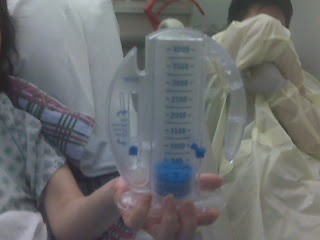
Mom laughed at us-- really laughed-- as we each tried her spirometer this evening (pictured in the previous post). Dad, David and I took turns inhaling while Mom watched, enraptured. The scene reminded me of any number of stoner movies in which the guys sit around in a circle, taking hits off a bong. Mom was raised in 40s- and 50s-era South Korea, a more straitlaced society than post-60s America, so I doubt she was thinking of bong hits while we tried to outdo each other's performance on the spirometer. To Mom, it was simply funny to see a bunch of large guys wheezing through a tube for no good reason other than to amuse her.
And for you neurotic germophobes: Yes, Mom is MRSA-positive, and yes, we all used her spirometer. But MRSA is spread through contact, and none of us actually touched the thing directly. How did we accomplish this? By forming an O-ring with the thumb and forefinger of one gloved hand, placing it at the end of the tube, and placing our lips on our own protected fingers. The best performance came from establishing a perfect seal: we guys all managed to top out above the 4000 mark, which is the highest you can go. Our hope had been that this would inspire (ahem) Mom to try the spirometer again this evening, but she was having none of it. Stripped of so many mental faculties, Mom was content to laugh at our clowning, and when we handed her the spirometer and urged her to try it, she simply regarded it fondly and did nothing.
While Mom's cheer was heartwarming, what we'd all rather have is a mom who can interact more meaningfully with us. Perhaps after she's gone through the next two surgeries, we'll have that mom again, even if not forever.
Final note: While I was walking, I wrote this very random meditation on breath and wind. Click if you're interested. And hope for the best over the next few days.
_
once more unto the breach
I arrived late this morning, around 9:15AM, but still managed to be there when Drs. Kerr and Leiphart stepped into the room. The upshot: the surgeons have to get clearance from Dr. Yoho, the infectious disease specialist managing Mom's current antibiotic treatment, but in all likelihood, Mom will be going in for a third surgery tomorrow, June 9.
"I don't want to go in and just do the same thing," said Dr. Leiphart, "and get the same result," i.e., surgery followed by yet more MRSA infection. His plan is to treat the infection as aggressively as possible, which will probably include scraping out the cavity in the brain where the main mass of the tumor had been removed. This will, in turn, mean cutting out "a couple millimeters of tissue," according to the doc. He will do his best to preserve Mom's "executive functions," but when I asked him how Mom will turn out-- cognitively and in terms of motor coordination-- his answer was a frank, "I don't know."
The surgeons are also going to speak with Dr. Yoho about the feasibility of feeding a catheter into the brain cavity so as to drip the antibiotic solution directly onto the infected tissue. I imagine we'll know more after this discussion occurs.
Dad has a long list of to-dos today, including a rather urgent dental appointment, as he lost a tooth last night. He'll be by the hospital much later today. He's managed to get in contact with MD Anderson, but is displeased that NCI hasn't gotten back to him yet.
Mom is lying so quietly on her bed in the hospital, fast asleep. She has no idea what's ahead of her. And I'm glad.
UPDATE: Mom ate nearly all of her lunch today, and even tried to vocalize a few times. One utterance was a distinct English "no" when I tried to feed her some smashed [sic] potatoes; another was a distinct Korean "aigo" (an interjection that can mean anything from "whoops" to "oh, my!" to "woe is me!") as she was fussing with her own clothing.
Mom was also able to shake her head no, something she hadn't done yesterday, despite being able to nod yes. Today, both "no" and "yes" were in evidence as gestures made with her head.
Just got news from Dad (who's been both at home and driving around on various errands) that some anesthesiologist called him, and it sounds as if surgery is a definite go for tomorrow. Like my brother Sean, who has expressed a great deal of frustration over how Mom's treatment has been turning out, I'm anxious about the prospect of more brain tissue being removed. Part of me feels that any surgeon's first instinct will be to cut out the problem, and I wonder whether tomorrow's surgery is really necessary. Why not catheterize the cranium and flush the site with antibiotics directly, then wait and see?
Dad's been trying to get in touch with both NCI and MD Anderson about Mom's treatment. Before Mom gets tomorrow's surgery, it would be nice to have a second opinion. The problem, though, is that the surgeons at Fairfax consider the infection problem to be urgent enough to warrant this very sudden surgery. The problem for us, as a result, is that we've barely had time to process the news that Mom will be undergoing a third operation, and further, that we'll have no time to ask anyone from a different health care facility to look at Mom and offer another opinion.
I hate this goddamn tumor. From the beginning, the tumor's aggressiveness has left us no time to consider options and organize treatment in other than a hasty, ad hoc manner. The infection is to blame as well, of course, but it's an unforeseen consequence of the initial surgery. The tumor is the primary culprit. Sean's frustrated question to me was something like, "Are they just incompetent, or is it really this hard to treat Mom?" I don't know; I'm not a medical professional. Mom has many nodules in her forearm veins, making it hard to give her a regular IV. Her lungs have always been susceptible to things like bronchitis and pneumonia (she may have pneumonia now, in fact, according to her recent chest X-ray). Her tumor is of the worst possible type. It turns out that she's among the 4% of people who get this sort of post-operative MRSA infection. How much bad luck can one woman have?
"Nothing they've tried has worked," Sean said, highlighting the competence issue. Mom's debulking surgery led to the infection. The radiotherapy and chemotherapy had to be stopped because of the infection. The second surgery obviously didn't get rid of all the infection. The post-surgical vancomycin regimen resulted in a serious, body-wide rash. The attempts to put an IV in Mom's forearm led to a series of-- as it turned out-- unnecessary needlesticks. The current daptomycin regimen apparently isn't working fast enough to combat the infection in Mom's brain. As you, Dear Reader, can imagine, this sort of track record doesn't make us hopeful that tomorrow's surgery will accomplish much of anything. There isn't even a guarantee about Mom's cognitive and physical states after the operation. So I understand what Sean is feeling, and although I'm inclined to believe the docs are doing the best they can, part of me wishes they could do even better. Much better.
In comparing this negative post to yesterday's somewhat more positive one, I think the reader should be aware that, from here on in, it's going to be an emotional roller coaster for everybody. There will be bright spots, of course; we can always hope that the tumor can be stopped in its tracks for a few years and that Mom can regain some of her original self over time. That would be the best outcome. But the bright spots will be far outnumbered by the difficulties that lie ahead. That's not pessimism talking; it's realism. If wishful thinking helps you, fine. It's not my way. I've never counted myself among the relentlessly optimistic; I find such a worldview to be a recipe for insanity. Hope has its place, but it's bounded by the dictates of biology and physics. False hope is the leprous offspring of one's refusal to acknowledge what's actually happening. So I'll keep hope, but won't give in to false hope.
_
Sunday, June 7, 2009
the day ends with Mom still in the hospital
In the context of Mom's rapid deterioration over the past few days, today was a day of small victories. Mom ate a decent breakfast, at one point taking the fork in her left hand (I had been feeding her) to scoop up some eggs on her own. She even reached out to grab a piece of bacon with her fingers, showing a measure of volition. She smiled and attempted to laugh on many occasions throughout the day, and once or twice gave Dad a dark look when he seemed to be getting too talkative with the hospital staff ("Ned, these people have other things to do and you're holding them up!"). Dad fed Mom at lunch-- an improvement over yesterday, when she didn't eat lunch at all. At dinner, David and Sean fed Mom, and at David's urging, Mom fed herself most of the time. Sean occasionally prodded Mom to eat when she seemed to hesitate: Mom would sometimes stare at her loaded fork or spoon, contemplating the contents with blurry fascination instead of simply eating the food. She did this with her iced tea as well, holding the tiny, foil-covered cup in her hand, contemplating its shape and the straw jutting out of the foil. one of us would have to prod her to drink.
Perhaps most remarkable was that Mom sat upright today. I had no idea she was capable of that, but one nurse, Vera (kudos to her, by the way: another good one at Fairfax Hospital), asked us whether we'd like to have Mom sit in a chair. I guess I'd gotten used to seeing Mom lying in bed, moving only rarely, the picture of helplessness. Vera's suggestion represented a welcome change of pace, and Mom proved up to the challenge: Vera easily maneuvered Mom into a sitting position on the edge of the bed, and with Mom's own help, Vera got Mom on her feet and rotated her ("We're dancing!" Vera chirped) so that she could settle straight into the chair that had been placed next to the bed.
Once Mom was in the chair, she seemed more awake and more interactive. The challenge of gravity may have motivated her to test the movement of her limbs and the strength of her neck. She held her head aloft the entire time she was in the chair, never once lolling, and that was where she ate her dinner.
Nurse Vera mentioned that it might be possible for Mom to interact with Sean's dog Maqz, but that the meeting would have to take place outside, on one of the green spaces. This was, I think, Vera's purpose in getting Mom to sit in the chair today: if Mom was able to perform that feat, she'd be able to sit in a wheelchair and be taken outside to see the dog. It's a great idea, and if Mom's going to be in hospital a few more days (at this point, we have no clue how long she'll remain), I'm fervently hoping we'll set up a play date for Mom and that perky charcoal chihuahua.
Later in the day, around 6:45PM, a different pair of nurses came to Mom's room and offered both to change Mom's bed linens and give Mom a sponge bath, to which Mom weakly agreed. Dad had left early to work on his ever-present mountain of paperwork (hospital bills are coming in... the parents have insurance, but a million dollars would be nice), and we three brothers took some time to explore restaurants near the hospital, quickly settling on a local Panera about two miles away.
Panera was apparently a major Korean watering hole; I saw at least three tables surrounded by young Koreans there, and one of those tables was actually two long tables doubled up to form one longer table. Panera's ambience is reminiscent of many of the shops now scattered throughout Seoul: well lit, lined with bland wood paneling, and sporting a Starbucks-style coffee-and-pastry bar on one side of the establishment. It's easy to see why the place would appeal to a younger Korean crowd. Sean, who cleaves to an Atkins regimen, had a salad; David and I had sandwiches and pastries, which turned out to be OK, but no big shakes.
Panera isn't the only place where I encountered Koreans. Because Fairfax Hospital sits next to Annandale's Koreatown, my peeps are everywhere, and that includes the roster of hospital staff. I've already spoken in Korean with two Fairfax staffers, and today I finally had the chance to exercise my French with two other staffers-- one a French Muslim from Lyon, the other a lady from Afghanistan who spoke a deliberately paced but picture-perfect French. This second lady told me that French was the first foreign language she'd ever learned. The first lady, la lyonnaise, told me I had a good accent. "You've still got it," was Sean's sly, sotto voce comment about my language skills. French proficiency was, for a good part of my life, one of the few things I could brag about. Even that, alas, has been deteriorating, especially after eight years in Korea speaking English and Korean most of the time.
Later in the evening, after I'd returned home and said hello to Dad, I spoke with two of Mom's Korean friends in Korean. Each of these conversations lasted around 15-20 minutes, and as anyone studying a foreign language can tell you, talking in a foreign language is always harder when it's done on the phone, because you're missing all the visual cues that help you understand your interlocutor in face-to-face interaction. Speaking in Korean is more of a struggle for me than speaking in French is; I stumble badly in Korean all the time, and usually end up speaking a mangled "Konglish" in which English expressions are routinely interspersed in Korean sentences. This practice doesn't make me feel too guilty, though: many Korean folks who have lived in the States have adopted the same habit. The only risk for such folks is when they go back to Korea to visit relatives, who expect them to speak entirely in Korean. Both Mom and my aunt experienced some rude awakenings when they were in Korea a few years back.
So for me this was, in some respects, a positive day. First, Mom was more active and interactive, and seeing her in that chair, upright after days on her back, was a delight for all of us. Second, as a lover of languages, I enjoyed the opportunity to chatter a bit in French and to fumble about in Korean. You don't get any better at anything if you never practice, and even after you've mastered something, you still have to practice, practice, practice to maintain and develop it. There's a spiritual truth in there somewhere. The Korean term man-haeng, the ten thousand (i.e., the myriad) ways, comes to mind: everything you do in life, from singing hymns to scratching your butt, is practice-- especially when done deeply and mindfully.
ADDENDUM: We noticed that Mom used her left hand much more than her right when eating; the right hand was either inactive or performed a subsidiary function, such as pushing vegetables into the spoon held in her left hand. When Mom was lying on her back in bed, her eyes and face tended to track left, as if she were more aware of things happening on that side of her head. This could be a sign that she's relying on her right brain to do a lot of the sensory processing. To encourage her to use her left brain more, Sean and David fed Mom dinner while sitting off to her right front side, obliging her to turn her head somewhat rightward to acknowledge their presence and to receive whatever help they were giving her.
In addition, we noticed that Mom's right-side limbs seemed to "come alive" while she was sleeping; her normally dormant or uncoordinated right hand would rise up and scratch an itchy point on her face, locating the itch with great precision and with more graceful coordination than was evident while Mom was awake. We have no idea what this means, but it's worth asking the docs about it.
_
a momentary distraction
Here's a little distraction from the relentless Momblogging.
Mark Steyn views President Obama as having offered a message of weakness to the world. Super Koreablogger Joshua Stanton, however, is pleased with Obama's handling of North Korea. Strength? Weakness? You decide.
_
she's eating
We've been at the hospital since 8:10AM. Mom is awake and reacting to our speech, even offering very weak laughter when we attempt to be funny. She's been eating her breakfast slowly but surely, and seems to have a decent appetite.
A doc named Josh, part of Dr. Leiphart's neurosurgical team, came into the room and talked with me for a bit. I asked him about the chronology of the tumor's progress, and whether the cross-hemispheric damage was something new. Josh didn't know, but did mention, in a general sense, that tumor regrowth was a possibility.
However, Josh did note, reassuringly, that the main problem seems to be infection, based on the observed rapidity of the spread of the damage. Unlike the tumor, which will never be entirely killed off, the infection can be fought and beaten. I asked Josh to confirm the chain of causation: "So it's infection, edema, speech problems?" Josh said yes. The bacteria in the abscess is causing swelling, and pressure from the swelling is affecting the brain's language centers.
Mom finished breakfast, and Dad helped Mom brush her teeth with an actual toothbrush. For days, Mom has had to use special "mouth swabs" (imagine a flimsy toothbrush with a tiny green sponge instead of bristles) to clean out her teeth and the inside of her mouth. We were hoping that she would enjoy a zesty session with the toothbrush, but we're not quite sure she understood what Dad was trying to do.
Right now (10:10AM), Mom's sleeping peacefully, having had a good breakfast and having enjoyed a bizarre experience with both an electric and a manual toothbrush. Dad and I are awaiting another team of docs, who may or may not already be doing their rounds.
UPDATE, 10:50AM: The swarm of docs came. What we now know:
1. The course of treatment will focus, first and foremost, on the antibiotic regimen.
2. The docs reiterated their uncertainty re: tumor regrowth, but lean toward the infection/edema theory to explain Mom's current language difficulties. Still, the docs haven't completely discounted the tumor as a possible causative factor in Mom's aphasia.
3. Replacement of Mom's bone flap might not happen at the end the 6-8-week antibiotic treatment period. It might take longer.
4. Mom's anti-seizure meds have been increased.
5. According to the chest X-ray, the lobe of one of Mom's lungs shows some sort of "consolidation," but the docs gave me the impression that this wasn't an urgent issue at the moment.
6. Although Avastin therapy had been mentioned during a previous visit, the doc today said that the team was still thinking of using it only as a second-line therapy. What's good about this is that the docs obviously don't believe the situation has become too desperate yet.
_
Saturday, June 6, 2009
not looking good
[NB: This post has been updated several times, so please scroll to the end to see those updates.]
We've been at the hospital since 8:05AM, and the Mom we saw didn't look very good. She was feverish, breathing rapidly and shallowly, largely unreactive, and completely nonverbal-- as close to a vegetative state as I've seen. She's not completely vegetative, however: she did chew and swallow breakfast, and she accepted liquids that we poured into her mouth. But she didn't seem to have the strength to suck down water from a straw, and the nurse had a great deal of trouble trying to get Mom to swallow pills. As recently as last night, that task would have been easy. Apple sauce turned out to be a clever lubricant.
Dad and I are distressed, as you can imagine. The docs will be on their rounds soon, we hope. Meantime, we're finishing up a late breakfast while we wait. In a few minutes, we'll be back by Mom's side. When we left Mom, she had resumed sleeping.
UPDATE, 11:29AM: I have a feeling that Mom isn't leaving the hospital today. She seems so much worse than she was yesterday-- and yesterday, she wasn't too hot.
Dr. Kerr, one of the neurosurgeons who worked on Mom, did some neuro checks with her about 25 minutes ago. His feeling is that Mom is suffering from "global aphasia," i.e., the breakdown of the pathways involved in both productive and receptive aspects of speech. This sounds right: although different family members have tried to reassure themselves that Mom "understands everything perfectly," this is far from obvious.
UPDATE 2, 12:25PM: Mom is being taken for a third MRI. It's not just the family that's worried and frustrated.
UPDATE 3, 5:55PM: We're still here (David arrived a little while ago, and I apparently missed Pastor Jeri). Mom's been visited by a few doctors, including Dr. Benson, a neurologist. His reading of the second (not the third) MRI is that "a significant portion" of the tumor remains. It also appears that the intracranial edema-- and whatever other damage-- extends across the corpus callosum from the left to the right brain. This damage (and I'm unclear on whether this is new damage) is likely the cause of Mom's periodic fevers. We still don't know whether the problem is tumor-related or abscess-related.
I forgot to mention earlier that Dr. Kerr is sticking by his seizure theory despite the EEG results. His reason for this is that it best explains Mom's "in and out" moments.
But sadly, Mom seems to be going consistently downhill for the most part. She slept through lunch, but did awaken for dinner, and has been reactive enough to eat, and even to drink from a straw.
UPDATE 4, 6:10PM: Pastor Jeri has returned, and Mom was visibly happy to see her. About 2 hours earlier, a crew came in to take a chest X-ray. Oh, yes: David reminded me that Mom visibly brightened when David showed her some cell phone pics of Sean's chihuahua, Maqz. She even produced a weak laugh upon seeing Maqz's photo.
UPDATE 5, 10:39PM: A special note: Many thanks to Yma (pronounced "Ee-mah") the nurse, who is easily one of the very best nurses we've had at Fairfax Hospital. She's very much on top of things, is quick to find solutions to problems, wastes no movement, and evinces no confusion. She's also extremely energetic and very friendly. Fairfax is lucky to have her. I kind of wish she could be Mom's nurse all the time. While most of the other nurses attending Mom have also been very good, Yma is definitely a stand-out. She radiated competence during the time I saw her.
My buddy Mike showed up around dinnertime; he met Pastor Jeri and sat with Mom, holding her hand. Mom was as glad to see Mike-- whom I've known since the third grade-- as she'd been to see Pastor Jeri. David couldn't stay too late because he had to go to work, but Mike invited Dad, Sean, and me to dinner at Sweetwater Tavern, which sits about a mile away from Fairfax Hospital. Sean was involved with a concert; he wasn't able to join us at the restaurant until after he'd finished his gig around 7PM, and had driven over to see Mom. He met us at Sweetwater around 9PM, and reported that Mom was fast asleep.
Toward the end of our dinner (thanks, Mike, for treating us), we got into a discussion prompted by Sean re: whether Mom needs to be moved to a facility that can deal more specifically and in a more timely manner with her various problems. Sean's point, if I understood it correctly, is that Mom's problems seem to be piling up, one upon the other, and a more dedicated facility like the National Cancer Institute or MD Anderson might be able to get Mom into MRIs faster, process data more quickly, and treat Mom in a more focused, efficient manner than Fairfax can.
But before we can leap to the conclusion that Mom will get superior treatment elsewhere, we need to find out how these alternative facilities would handle Mom as she is now. At this point, we're facing the possibility of tumor regrowth, and/or the return or worsening of the intracranial abscess, and/or post-operative cerebral edema, any or all of which might be exacerbating Mom's condition.
So Dad, who has been the by-phone liaison for the various health care facilities, has been given the assignment of calling up MD Anderson and NCI to talk with docs at those places about what they might do, were they treating Mom, and whether they truly can, at this stage in Mom's treatment, offer a better alternative for Mom than what Fairfax can provide. Dad will be leaving messages at MDA and NCI tomorrow (Sunday); we hope to hear from the relevant offices on Monday.
In the meantime, we'll be heading back to Fairfax early in the morning, waking up at 6AM again and arriving at the hospital around 8, as we did today. Our purpose is to catch the doctors, ask them about the chest X-ray results and the third MRI, and also to ask the tough questions about what more can be done for Mom. Sean mentioned, yesterday, that one doc had talked about putting Mom on an Avastin regime. Avastin, according to Dr. Meister, is generally a second-line treatment, i.e., it's the weapon you bring to bear against the tumor only after the initial standard therapy has been done. To hear that it might be needed now is disconcerting, but at the same time, if it's what needs to be done, then my feeling is "Hell, yes-- put her on the treatment!"
One thing I personally want cleared up is whether the second MRI, which was discussed by the neurologist Dr. Benson, showed new damage to Mom's brain, or was merely showing us a better picture of damage that had already been there from the beginning (April 16). I had tried to ask a similar question when I'd spoken with the doc, but I didn't ask it very clearly, and his response was similarly unclear as a result.
Dad and I are home; we got here around 10:25 or 10:30. Tomorrow, we do it all over again, trying to catch those doctors during their early rounds. As you probably guessed, Mom is in no condition to be discharged.
Today wasn't easy for me. After hearing from Dr. Benson about the cross-hemispherical damage that was (1) probably linked to Mom's fevers and (2) a possible indication of tumor growth or regrowth, I admit I spent a few moments holding Mom's inert hand and silently crying. Later on, when Mom became more reactive around dinnertime, this felt like the first blooming of spring.
Alas, arduous days like today are only going to occur with greater frequency, because that's the nature of GBM. In a perverse way, Mom is better off not being fully aware of what's happening to her.
_
Friday, June 5, 2009
where do we go from here?
Dad and I plan to be at the hospital at 8AM on Saturday morning. By then, Mom will have been done with her MRI, and there's the slim possibility that someone will have had the time to look the MRI results over, and will be able to talk with us about them.
We're trusting the hospital staffers, who told us that Mom would likely be discharged on Saturday. There's always a chance that this won't be the case. As happened last time, the docs might feel that Mom's cultures* have come back positive for something, or they might discover that Mom has developed new symptoms, etc., necessitating a delay.
The InfuScience people (the ones managing the daptomycin regimen) have told me that they're flexible: if Mom has to stay an extra day at the hospital, they can schedule around her. Ideally, what will happen is that Mom will have one dose of the dapto before leaving the hospital on Saturday; not long after, she'll be discharged. We'll receive a call from an InfuScience rep later in the day, and will be visited by an InfuScience nurse-- just as happened last time when we started the vancomycin regimen-- on Sunday. Since we now know how to administer doses through Mom's PICC line, there's no need for another training session. The only major change is that the dapto will be administered only once per day, and will take only 30-60 minutes to empty into the bloodstream, as opposed to three hours. Blood samples will be taken once a week to determine how Mom is responding to the dapto.
Beyond Sunday... I suppose the main goals will be to (1) understand and attempt to eliminate the source of Mom's aphasia and cognitive impairment (the key to this is the latest MRI, which ought to tell us what's actually going on in Mom's head), (2) get her safely through the daptomycin regimen and back onto the chemo- and radiotherapy schedule, and (3) get her bone flap replaced with synthetic bone once the dapto regimen is finished in the next 6 or so weeks.
Beyond that, we'll be looking to get Mom through her 6-week chemo- and radiotherapy calendar. At the same time, because her surgical site will have been opened a third time for the new bone flap, we will once again have to be mindful of Mom's healing, taking pains to guard against even the most minor infection.
None of this will be easy, and the burden falls mostly on Mom, who at this point might not even fully understand the challenges that await her. I know it's my own nightmare: to be faced with a dire situation, but to be unable to do anything about it because I don't even realize how dire it is.
NB: If my narrative often sounds more like a dry recitation of facts than an attempt to weave an interesting story, that's partly because I'm using the blog as a sort of note pad for my own benefit. It may be necessary, at some point, to present a doctor with a chronicle of events. Instead of trusting myself to keep the story straight in my head-- which will never happen-- leaving this testimony in the semi-permanent medium of cybertext means that I can retrieve data at will, im'sh'al-Lah. Or in this case, im'sh'al-Google.
*The most recent set of cultures were to be held for 48 hours.
_